One of the biggest questions I keep seeing about Old-School Essentials is, “What vintage adventures are compatible with the system?”
The most common refrain to this is, any vintage TSR module–but be careful using AD&D modules, because the AC will be off by 1.

Let’s put aside, for the moment, that one should never reference exact stats for a different game than the one you are currently running–if the module calls for an orc, you refer to the orc from Old-School Essentials, not the printed stats in the module. Even if they match, or OSE purports to be an exact match, you should abide by the stats of your system–not the module.
Also, if the AC is only off by 1, that’s 5% chance on a d20. Will it break the game if the AC of the orc is 6 instead of 7? Absolutely not. It should be fine to just ignore.
But, I wanted to investigate the wisdom. Is it actually true that the AC is off by 1? Let’s do the work.
Read more: AC in OSE, AD&D, and ModulesTo start with, we’re gonna need the basic AC values from OD&D (I will get into why in a moment), B/X, OSE, and AD&D 1e’s Player’s Handbook. The OD&D values were actually quite hard to find; I couldn’t find an exact match in the Men & Magic book to just tell me if Plate Mail was AC 2 or what. I couldn’t find it quickly detailed in Chainmail or Greyhawk, either, and had to resort to Delving Deeper (I double-checked against Fantastic Medieval Campaigns for accuracy):

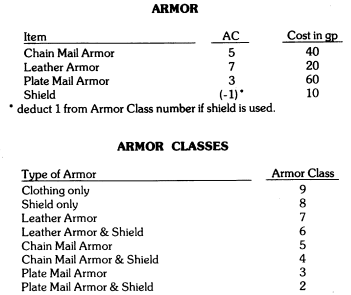


Here we see, indeed, that the base unarmoured AC for 1e is 10, rather than B/X and OD&D’s 9. Fine, seems like everyone is right, and we could end it there. But…there needs to be more interrogation.
You see, AD&D 1e’s Monster Manual was released in 1977, before the Player’s Handbook and Dungeon Master’s Guide. And I have long heard that the Monster Manual simply reused many of its stats from OD&D, rather than updating them to the AD&D AC standard–indeed, it may be that at the time of the Monster Manual’s publication, the new standard had not even been created yet.
So, we need evidence. Let’s grab orcs. They’re in every edition of the game and we should be able to look at them easy.
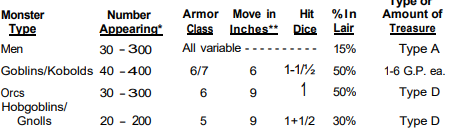

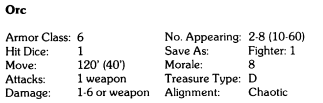
Wait. What the fuck? Why are orcs at 6AC still in AD&D? Leather armour is 6 AC in B/X and earlier, but 6 AC in AD&D is studded leather. Are AD&D orcs wearing studded leather? Or perhaps scale mail? Their description offers nothing.
It’s possible the AC values for AD&D are supposed to simply be abstracted–orcs have 6 AC, and it’s up to the DM to determine if this means they have studded leather, ring mail and shield, etc. Hey, who am I to argue?

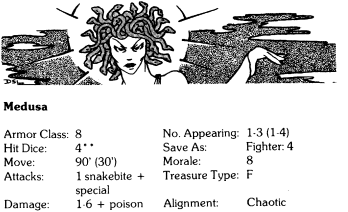
Some of the monsters just are straight up different, which helps no one.


So, here’s what we’ve figured out: The monsters in the AD&D 1e Monster Manual do in fact conform to OD&D and B/X AC standards. In most cases, where they aren’t changed entirely to something clearly different, they opted to simply leave the AC the same and not bother to “adjust” to what it “should be” according to the new scale. In cases of humanoid men, typically they included a %-based table of what equipment they had; in these cases I assume you were to use the PC-facing armour class table to determine their AC. But an ogre just has AC 5, no matter if this scale is different.
But…this whole thing kicked off because of modules, not because of the AD&D Monster Manual. By my own admission, one needs not look at the AD&D Monster Manual at all, merely what is in the modules. Well, I wanted to do the research, because I need to know: Are the monsters as printed in modules bespoke, or are they simply reprinted from the Monster Manual?
To check this out, we’re gonna start with a couple famous modules that are likely to be rec’d and used in OSE’s format. Let’s start with T1: The Village of Hommlet, and see if we can’t find a few of the baddies we’ve already looked at.
Of first note, there’s some bandits and included is the table of what AC they should have based on their equipment–helpful. Let’s compare these AC against OSE:
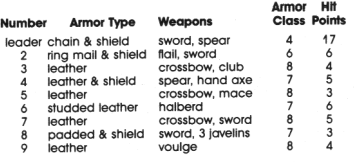
So, their AC actually is going off the AD&D PHB, meaning their AC is actually worse than if we just used the proper values for OSE. If you use these values, the bandits will actually be easier to hit than they were in AD&D…maybe. I gotta be real: I’m not an AD&D 1e expert and it’s possible the to hit and STR modifiers are different enough to account for this.
Here’s our ogre friend, with 5 AC as expected. The same as in OSE.
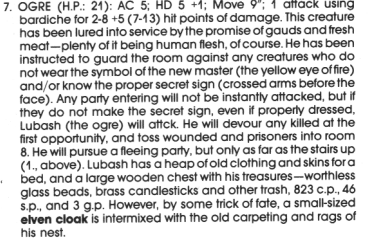
Let’s move on to N1: Against The Cult of the Reptile God, a classic. This has no orcs but it does have goblins:


I could go on with more deep diving into old modules, but based on these two examples, I think it’s safe to say that the standard was to just grab the stats from the Monster Manual and reprint them. So, even less than we’ve thought, do we need to worry about the difference in AC.
