Thirty and counting.
Connoisseur of fine trash.
Not ever gonna make it,
but then again, who does?

The dice exist to resolve ambiguity.


GOOD POSTS:

  • Megadungeon Treasure Generator

    , , ,

    Maybe this is a misnomer. I don’t know! I built it for megadungeons.

    A problem I have when writing a dungeon is that I often have a set amount of gp I want to give out, but just putting a pile of 4000gp in a room is fucking stupid. I need semi-interesting treasure generated, which I can then riff on and make more unique and actually interesting for the players to interact with. (At least as much as any player thinks the treasure is interesting.)

    So I made this on Perchance. You put in a number, and then it generates a treasure hoard that is…well, a little bit over that number. (I couldn’t get it perfect. Sorry. Maybe I’ll go back and fix it up later. Or if you’re a wizard, you can do it and then let me know.)

    I tried to embed it here all fancy-like, but WordPress kept deleting the iFrame I used. (LMK if you know how to fix that.) So instead, here’s the link: https://perchance.org/19lcfg71ts


  • B/X XP Table Percentages

    , ,

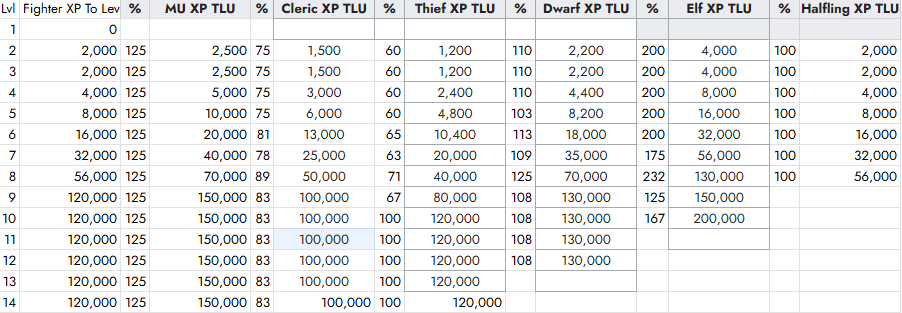
    In earlier editions of D&D, characters level at different rates. A 2nd level Magic User is more powerful than a 2nd level Fighter, and so requires more XP to become level 2. According to the tables, a 2nd level Elf is almost twice as powerful as a 2nd level Fighter.

    I’m not here to argue if this is good design or not or if these numbers are good. I simply wanted to take the XP tables, extract the numbers, and see what percentage each was worth. How much more % XP does a given class require?

    I used the Fighter as the baseline, of course, because they’re even and middle of the pack.

    Might replace this with a table insert later.

    Some of them move around, like the cleric and thief. Others are fairly consistent. But if you wanted a simple modifier, here’s one:

    Magic User: 125%
    Cleric: 75%
    Thief: 60%
    Dwarf: 110%
    Elf: 200%
    Halfling: 100%

    Using these percentages, you can very easily make your own XP tables. No longer are we chained to the exact progression Gygax made. For example, here’s a fun experiment: Let’s take the 5e XP values (up to level 14), apply them to the Fighter, and extrapolate from there:

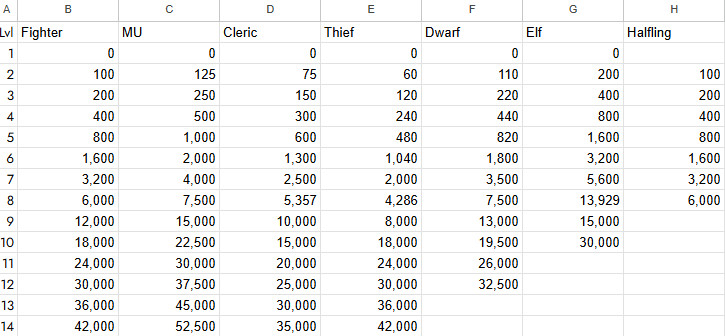
    The next step would be, of course, to figure out what percentage the Fighter table is between levels, as it’s mostly variations of doubling. Once we do that, it’s trivial to simply take the amount the Fighter needs to level up to level 2, and from there, we can literally extract the entire level up table. Like so:

    Entire XP tables based off the Fighter needing 100xp to level up to level 2.

    Now, probably shouldn’t be that low, for a proper B/X or OD&D game, especially if you’re using 100xp per HD base for monsters. (In the future this will probably link to an article; I’ve got some words to say!) But, if you’re only awarding XP for gold, or XP in some other fashion where you are as arbitrary as you want to be, maybe these numbers look pretty good?

    Wanna play around with it yourself? Here’s a link to the Google Sheet. Copy for your own reference. Place the XP value to level up to level 2 in cell B3 (the green one) and the entire list will auto-populate. If you’d like more hands-on control of between levels, just put them in column B and the rest will autopopulate.


  • Dominoes Dungeon

    , ,

    It’s simple:

    A set of dominoes has 28 tiles. We take those 28 tiles, and we assign each a pair of rooms. Arrange the tiles as you like. (I don’t know how to play dominoes. Fuck it.) This gives you 56 rooms, including special hallways (the blank tiles).

    I used the d6 drop table procedure from Cairn 2e for this, but ended up modifying the order slightly. (0 Hallway; 1 Special; 2-3 Lore; 4-5 Trap; 6 Monster.) So, you can use the d20 tables in that to generate what’s actually in the rooms. Or, modify that original d6 list and tailor the distribution to your heart’s content. (Honestly, “Treasure” should be an option here, but I already made the table.)

    This table is formatted so you can write up what’s in your rooms on the right.

    Would love to hear ideas about how to make this better. Hit me up on bsky or tag me on Discord; I’m in all the cool OSR servers (@onslaughtsix).


  • Overloading The Treasure Die

    , ,

    Inspired by Prismatic Wasteland’s Overloading the Encounter Die
    Also inspired by tables from Maze Rats
    Also initially inspired by the loot table in &&&&&&&&& Treasure by Luke Gearing, though all work from that has disappeared from this version.

    I hate rolling up treasure hoards. I’ve never found a good way to do it, either quickly or efficiently. It is the bane of my prep, the bane of my games. Once there is just a general description of some treasure, I can expand on that improvisationally–but coming up with that initial spark is very difficult for me. So, I did the work, and came up with a way to roll this shit up very quickly. You need 3d6 and the monster’s number of hit die, and these tables. (You can also make your own tables. Have fun!)

    This is best used during prep of a dungeon, focused around a hoard belonging to a specific creature or faction, or at-the-table for random lairs (such as finding a “% in lair” monster). It is not particularly useful for on-hand individual monster treasure (as it’s too involved and not fast enough at the table).

    (more…)

  • Encounter Chains

    ,

    The best thing I ever did for my big-ass hexcrawls was establish what I call “encounter chains.” This is a series of escalating encounters with the same faction or NPC.

    For example, a roving band of orc cultists cutting off people’s left hands. (I can’t take credit for this idea, it’s a riff on this.) The first encounter in this chain actually isn’t the orcs at all, but the result of one of their attacks–an upturned cart and a family of five (man, woman, three children), with the father’s left hand cut off and taken by the orcs. This is a fantastic non-combat encounter that lets you drop info about the orc cult and lets the players figure out all sorts of stuff–turn the cart back over, collect their scattered remaining supplies, offer some of their own, calm down the children, potentially healing magic on the father to at least stop the bleeding and cauterize the wound. Great stuff.

    Then, the next time they find the orcs attempting to knock over another cart. This time the players can stop it. Whether any survive or not, the orcs will be aware that some group of assholes is going around cutting up their cult members, leading to the next encounter where the orcs have definitely set up an ambush for the players.

    Eventually, of course, this all has to lead back to the players asking an orc who they’re with, where they live, what their goal is, and now there’s an orc lair on the map somewhere and the players will be figuring out how to lay siege on it.

    Now, do this for three or four other things. For example: A guy who keeps ending up in mischievous trouble. Buried up to his neck in the middle of the road, enchanted by a satyr and strung up in a tree, stuck in a barrel in the river. Eventually this guy could be revealed to be a powerful NPC ally in disguise as a schmuck to throw people off his scent; a spy from a powerful organization, sent to deal with the same problems the PCs are dealing with (such as our orc cult).

    Other simple examples: A group of roving barbarians, trying to summon a thunder goddess to cleanse the land. A migrating group of treants. An old man, with one eye, attended to by seven canaries, who turns out to be Bahamut, or Odin. A hungry dragon driven from its lair by evil adventurers. Etc. Be creative. Use whatever stuff you like. You can even pull the plotlines and factions from your favourite modules and drop them in, creating the powder keg effect (article forthcoming).

    Once you have three or four of these encounter chains set up, scatter them on your table amongst other, single-service encounters–some just straight up combat (there’s a bulette! attack/run!), some avoidable (an Ettin is in a field looking for easy hunting prey), some unrelated people (like merchants or lost travellers).

    Keeping an even keel between “random bullshit” and “ongoing plot threads” means the game never feels stale, and the players are never overwhelmed by too many threads to keep track of. I don’t recommend any more than four encounter chains at once; any more than that and the players could start to get overwhelmed by ongoing plot threads. It also helps if each encounter chain has a different amount of encounters in them–one chain that can be “solved” in three encounters, one that’s six or seven, one that’s about four. You can alter this based on the vibe of your table and campaign; if you had an encounter chain with five or six encounters and the players are clearly beginning to get annoyed, just jump to the end.

    One thing to keep in mind is that you don’t have to develop every encounter in the chain at the beginning of your prep. You just need the first encounter. Once the players hit upon it, cross it off the encounter list and repopulate it with the next encounter between sessions. Easy money. You can also take any random encounter you’ve used and then decide after the fact to expand on it; maybe you introduce a merchant NPC and play him a little weirdly, and the players are interested and start speculating. Great opportunity to take that guy and turn him into an encounter chain!