The following post is a cleaned up version of an old Twitter thread.
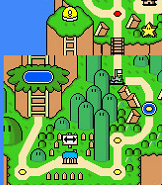
THIS is a point crawl map.

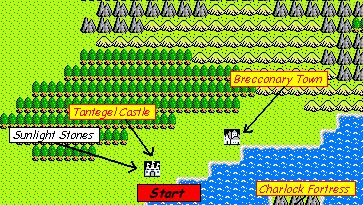
THIS is a hex crawl map.

Hopefully you are familiar with Super Mario World and Dragon Quest, but if not, I’m sure you have other examples that work and illustrate the point enough to grok the differences. The hexcrawl has to cover objective distance; the point crawl is paths between distinct locations.
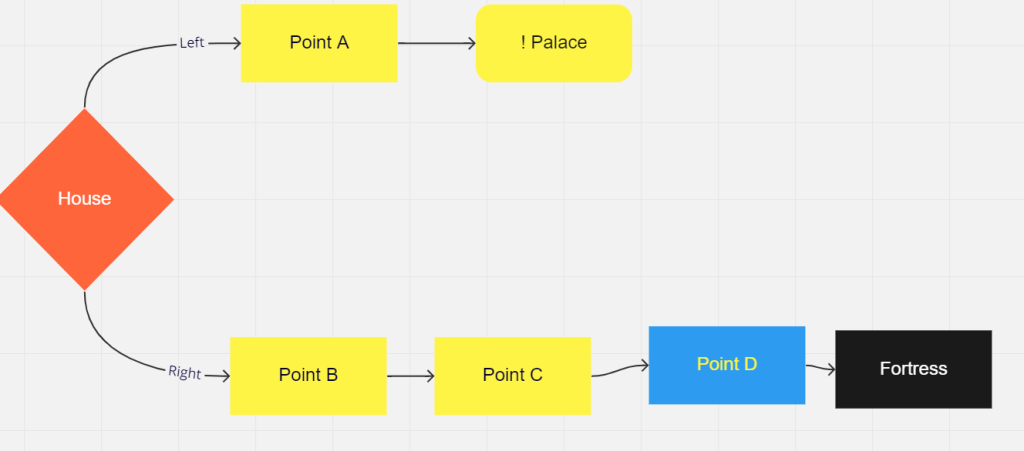
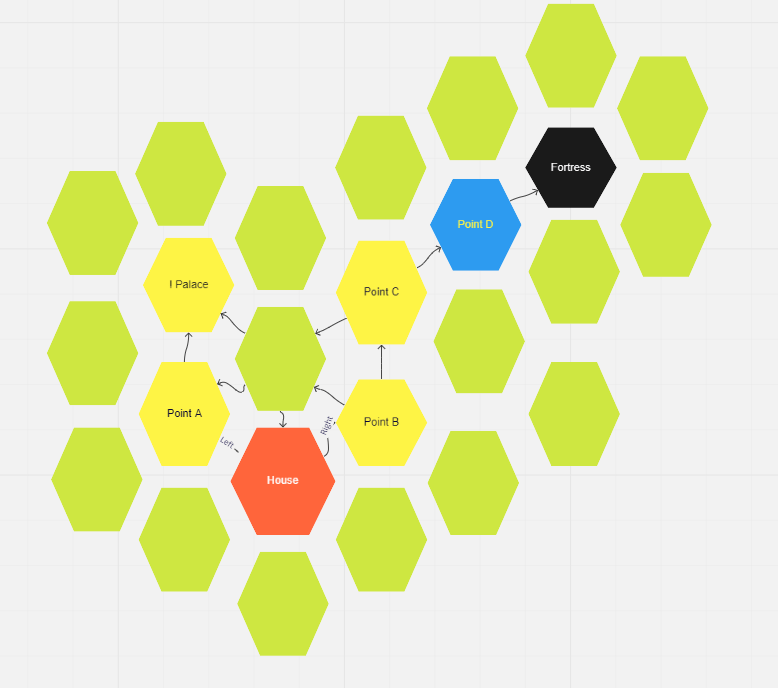
For example: the distance from the house at the bottom of the map to the 2 top elements. Take the left path, you encounter 1 yellow point and the ! button. Take the right path, you encounter 3 points and a fortress. Objectively they are the same space, but less “content” on left.
If we wanted to map this area with a point crawl, it might look something like this:
Meanwhile, look at this just tiny section of DQ1’s map and how much less content there appears to be, but you know that you’re going to be all over those woods & hills looking for shit. In DQ1 it would be random encounters, but in theory anything can be there.
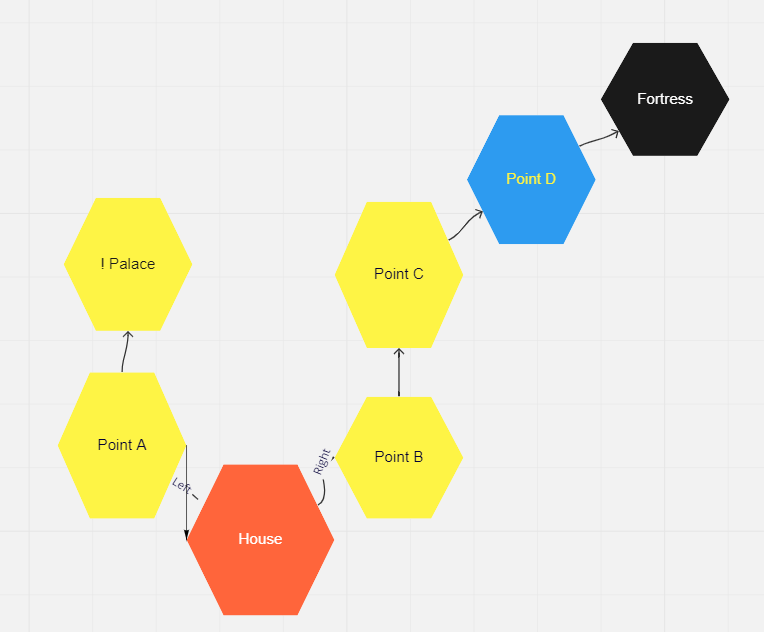
For fun, on my Miro board here, I changed everything to hexes and aligned them a little bit more in the orientation we might expect for a hexcrawl. Now, these are distinct “levels” or points of interest. Maybe each one is a town, or just a random encounter.
Real quick: let’s say Point A is a goblin fight. Point B is an orc fight. Point C is a displacer beast. Point D is a seaside port town. ! Palace is a friendly witch hut. Fortress is the boss’s stronghold. Just to help contextualize these in a fantasy adventure.
Now with a little bit of work I turned it into a hex crawl. (Please ignore the lines as they are rapidly becoming worthless). We could do something like simply put a road between the House and the Fortress to encourage staying on path to use our content (points B, C, D) or we can embrace the futility of trying to railroad the players into a set path and let some of those encounters become a random encounter table–or even a linear list. It’s your game, you can decide they fight goblins, then orcs, then a displacer beast, regardless of “where.”
So now I enclosed the whole thing in water; it’s a small isolated island. The enemy fortress is surrounded by mountains that the players are ill equipped to climb, so the only way in is through the road & the town (Point D).
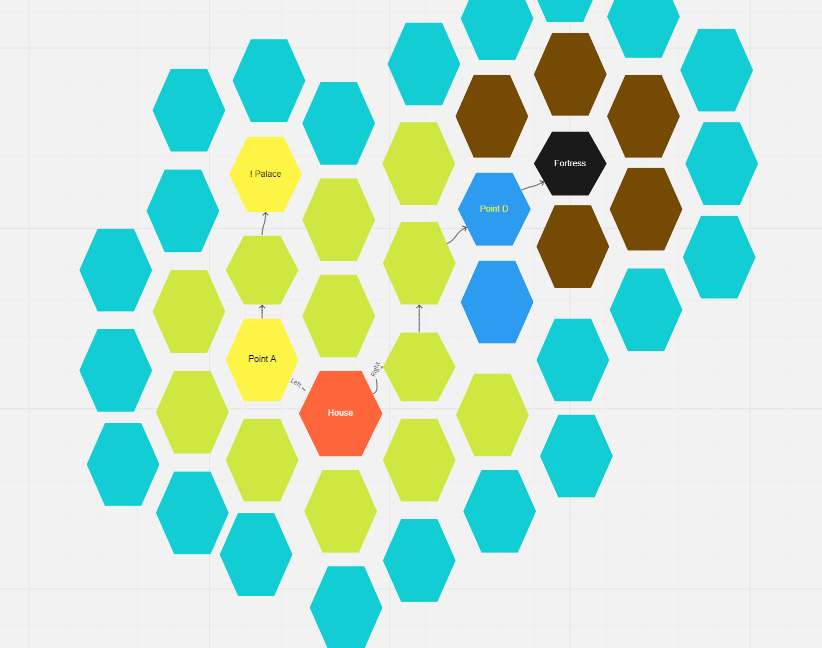
Design wise I have created literally NO different content from my point crawl earlier, I’ve just slightly altered the processes by which the players engage with it. The experience is at the core the same–a goblin fight, an orc fight, a displacer beast, a town, a fortress.
Which design style is right for you–your prep, your campaign style, your players–is up in the air. Use what works for you and your table. But they’re all related, they are all at their core the same content, just presented slightly differently.
