It has been fifty years and I don’t know the difference between a ghoul, a wraith, a wight, a ghost, a spectre.
I’m done! Fuck this! It’s time to A) figure all of this out and then B) solve them for my own game and setting.
I do not care how these terms were co-opted by Gary (or Dave, or Rob and Tim or whoever else). I am only interested in figuring out what they are for me, and extrapolating from there.
Similar to what I did with demons in Castle Gygar, I’m primarily interested here in tamping down the list of All Possible Bullshit into a sort of “master creature.” Instead of making multiple statblocks for individual recurring demons, I simply added them all and assigned each a “Type” (classic Eldritch Wizardry shit) and made that equivalent to HD. A Balrog is a 7HD Type VII Demon. It’s 90% the same creature as a simple imp or Pinky demon, but it has 7HD (thus giving it the saves of a 7HD monster) plus any special abilities it needs.
I think this should also be true of most Undead for my game. Big named undead, or special creatures like a Death Knight or something, can have a unique statblock. But skeletons, ghouls, spectres? Let’s just make them all one. More importantly, let’s figure out why these undead exist and how they get to where they are. But, that’s revision stuff. First we have to figure out what the individual undead are in D&D.
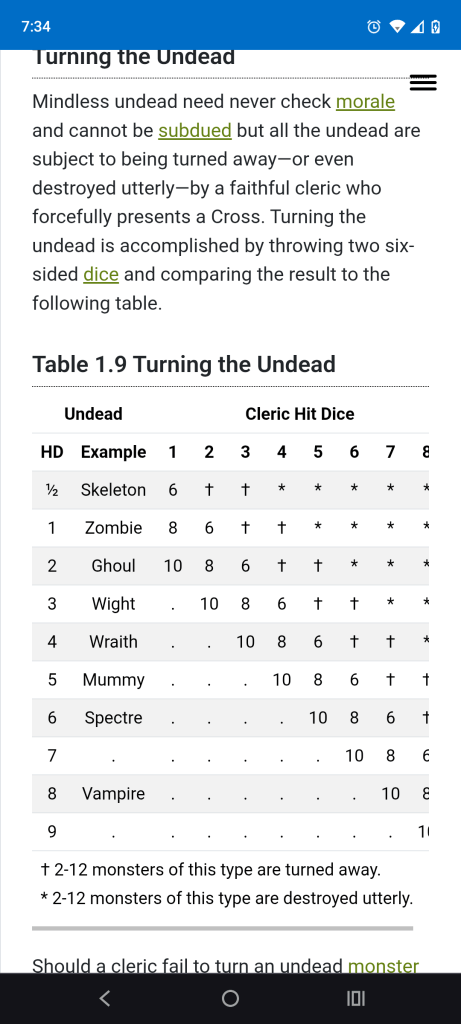
First up: Delving Deeper has its fucked up Cleric turn undead table. (I say it’s fucked up because it cares about the Cleric’s HD instead of their level title. One of those little differences DD has compared to the original text.) This is actually 100% useful because it quickly separates out the OD&D undead by more or less HD, giving us the same general template as our Demons! Great! So, let’s start there and work backwards.
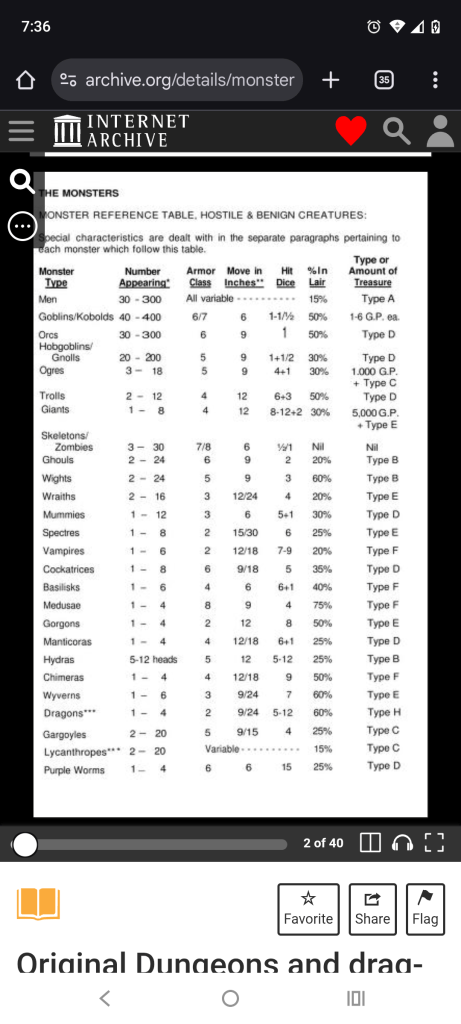

Helpfully, Gary’s OD&D just straight up lists them in HD order instead of alphabetically. Did Gary know this is how people actually wanted to keep track of The Undead? Am I secretly finding out this is how it was always supposed to work???
- Skeletons are self explanatory. A skeleton gets reanimated. OD&D seems to specifically imply that a Skeleton needs a master necromancer to raise them; something I don’t think is as important. (More on this later.),
- Something that’s always bothered me is that “Zombies” basically do not seem to be zombies in D&D. When I think zombies, I think Resident Evil or Dawn of the Dead, where people get infected (usually through being bit) and become a zombie. Whether a zombie bite is lethal or not is sometimes not important; when you get bit you become infected and then when you die, you become a zombie. Sometimes the death isn’t even important; when someone gets bit there’s a certain amount of time before they “turn.” (I was going to actually also reference the movie From Dusk Til Dawn here until I realized those aren’t zombies at all, but fucking vampires. In any case: zombies do not appear in Castle Gygar and I don’t think they should be part of this case of “general undead.” We’ll be excusing them from the party.,
- Ghouls have a paralyzing touch that (for whatever reason) Elves are immune to. (I have heard this was a game balance concern in Chainmail; that Ghouls were particularly cheap to purchase for your army and Elves were a way for the opponent to offset them. I have no idea if this is true.) It also states that any “man-type” killed by a Ghoul becomes one. It is generally assumed that this refers to “normal men” or 1HD or less opponents; a fighter of at least level 2 would not turn into a ghoul. In many ways, this actually makes the Ghoul closer to what we imagine the Zombie to be in pop fiction.,
- Wights drain “life energy,” destroying your HD and apparently making you less capable of fighting. This implies level drain.,
- Wraiths are higher HD wights with different weaknesses. Boring!
- Spectres are incorporeal and drain 2 levels when they hit. Deadly boys!,
- After this is the Mummy and Vampire, two creatures who IMO should absolutely not be on this list. They are individual creatures and shouldn’t be part of this list.,
Also, here’s a fun story: We were playing in a pretty brutal 5e campaign set in a deadly desert. We’re level 3; maybe we got to level 4 by the time we got to the pyramid. My friend Andy was running the game and had never actually run D&D before (any edition). So, after some brutal shit on the way to the pyramid we finally get to the entrance. And we come in and there are four sarcophagi on the side walls. So we go poking around hoping for treasure or magic items and of course, the sarcophagi open and four shambling corpses in tan-white wrappings come out. And we’re all like, oh fuck, mummies! Well there’s four of them, so we should be pretty okay…figuring that these are just reskinned Skeletons or Zombies or maybe even Ghouls, right? That’s when one of them hits me and I contract mummy rot.
I said, “What the fuck! These are actual mummies!” And my friend Andy goes, “Well yeah, of course they’re mummies. I just put them in there.” I went, “Dude! Did you not read the mummy statblock beforehand? Look at what CR these are, look at how many hit points they have!” And he goes, “OH FUCK! No! I just thought they were like…you know, mummies! Dead guys in toilet paper!” “No dude! Mummies are like, right next to vampires. They’re like huge high level enemies. If these are legit supposed to be four mummies then this is a TPK.” Fun story!
So, what did we learn? We learned that in OD&D, they aren’t any different after ghouls. Well that sucks and I hate it. And, Shadows aren’t even in OD&D? It turns out Shadows are the only thing with Strength Drain as opposed to Level Drain. Well, we can’t fucking have that, that sucks ass. So we’re gonna have to redesign these guys from scratch.
So first up: What’s an Undead? In my world there might not be any necromancers. The concept just doesn’t work that way for me. (I’ll circle back around to this at a much later time.) So instead, what happens is when a person dies, and their body is not put to rest, it will eventually rise as an undead. Clerics can perform funeral rites that prevent this from happening.
The amount of time it takes for a body to rise is 1 week per level or HD, meaning for most people it takes a week. This means that when people die, there is generally one week’s time to perform a funeral for them. This also means that’s how long you have to pay for resurrection. (The act of the funeral and the actual act of interring the body into the ground are not actually related. It’s complicated!) Funeral rites are also fairly simple, especially if you don’t really know the person you’re putting to rest. If you don’t put them to rest, Bagu the Riverman will refuse their passage on the River Styx and their soul will be forever lost in it; their body will then rise as it attempts to find someone to put them to rest, but the soul is no longer there. So, each Undead forms from someone who has actually died and not been properly put to rest. Generally, if no one is around, the bodies do not animate, but as soon as someone starts poking around, they’re liable to rise up and start stabbing. It would be nice if your HD corresponded to what you rise as, but that’s not quite possible with the way I want to do this.
- 1HD: Skeleton: Arguably, the Skeleton should provide no special abilities, being the most mundane of all monsters.,
- 2HD: Ghoul: All Ghouls are Dwarven in my world. Dead Dwarves rise as Ghouls. Their paralyzing touch actually turns to stone, since dwarves are made of stone in my world.,
- 3HD: Spectre: All Spectres are Elven spirits. Because elves don’t die of old age, their spirits persist even when their bodies disintegrate. These guys get STR drain.
- 4HD: Wight: Higher level humans. I think these guys should have “HP drain,” which is different from “level drain” as it existed in OD&D and etc. So, they hit you for ~1d6, and then that comes off your maximum HP until you take a long rest.,
- 5HD: Wraith: So this is my concept: Level drain sucks, no one likes it. Instead, what a Wraith does is drain your XP. If you’re a 2nd level fighter, you don’t just have 2000xp, you probably have 2600 or 3200 or something. The Wraith drains that. It drains your excess XP over the threshold for your most recently level. So your 3200xp fighter would go down to only 2000xp. Here’s the cool part: The wraith is now worth 1200xp more (plus the 500xp he would have for being a 5HD monster). When the wraith dies, that 1700xp is divided evenly among the party…so you even get some of your XP back at the end. This is much more interesting and cool than just “fuck your level.”,
- 6HD: ???: Don’t even know what these guys would be. Maybe they have proper level drain, with some other method similar to above. Or maybe not! Who knows!,
So, that’s what I’m doing for undead. Stay tuned for a properly formatted statblock at a later date.
