The ‘reaction roll’ is something I’ve always struggled with in OSR games. Putting aside that I come from a more story based, new-school ‘the DM can just decide whatever they want’ philosophy, what it really comes down to is that the table sucks.
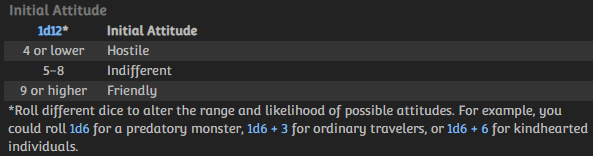
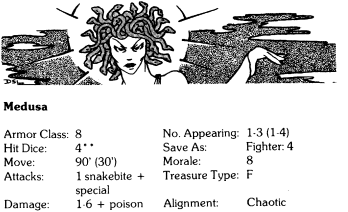
Various reaction tables from OD&D, OSE, AD&D 1e, 2e, and 5e 2024.
As I put the final text into layout for Castle Gygar, I’m thinking a lot about how I want to see monster statblocks formatted (and the ridiculous amount of space standard OSE statblocks still take up). One bit has been sticking out to me, the Morale check. Even as I run my play-by-post OSE game, I forget to check it, which means it essentially doesn’t get used. How can we make this number more useful?
Maybe we should roll it into the reaction rolls. The reaction roll tables are annoying because so much of the table either doesn’t matter or is unclear. Neutral, unsteady reactions don’t really interest me or give me anything to riff on as a DM in many cases. I find it works best if the monster is simply hostile or friendly. A ‘friendly’ monster doesn’t even need to immediately be all buddy-buddy with the party–maybe this is what they mean by neutral, but it never feels that way to me.
The easiest thing to do is simply say that a positive reaction roll is any that exceeds the Morale score. You meet a new monster or group of monsters, you check morale. You can even adjust this for Charisma. It’s almost brilliant enough to work?
It might break down with certain big ass boss monster NPCs who you also want to be friendly. For example a Red Dragon’s got 10 morale, so you need to hit 10-12+ to get it to even talk to you. But again, there’s always the adjustment, and of course the DM Fiat. Remember: the dice exist to resolve ambiguity, not infer reality.
I’m gonna try it out. Worst thing that happens is it sucks!
The difference between a heartbreaker and a craphack is, you think a heartbreaker will be finished.
I started using the word “craphack” a few months ago to talk about my in-progress fantasy d20 elfgame. (This is a separate project from CRAWL, which has entered a process of hibernation. Its no longer in active development.)
I had a lot of names for this thing. It really started when the OGL shit hit the fan and I was already seeing how affordable low-run booklet prints were. The idea of creating a booklet with a bunch of my house rules and favourite tables, and getting it printed, became a kind of cool idea. Simultaneously, WotC quickly jettisoned a bunch of the coolest ideas for 5e 2024. Initially I was like: well, let’s compile those ideas and I’ll make a home game out of what I liked.
I called this document 5e Killer. This stems from a phrase I said in early 2023: If you are a major TTRPG publisher and you aren’t already working on your 5e Killer for release in Fall 2024, you’re fucking up.
I am not a major TTRPG publisher. But why not do my own? At least for my home game.
Last October I was talking about Hit Dice, Hit Points & Weapon Damage in my various games, and how I want to work to unify some of this.
Since that post I’ve thought a lot and want to move forward with things it does, and this required a few changes. First up, I recategorized the classes:
Couple things: I will be adding a feat that allows you to bump your Hit Die to the next die up (maximum of d12). I like feats in my games! I think big chunky complex games like what else should have lots of customization options.
Under this system, your hit die is also your hit die, as in the die you roll for damage. Your character does damage, not your weapon. That’s not to say weapons won’t have differences; I am much more strictly implementing a “light/medium/heavy” system and locking those weapons behind class proficiencies. I prefer light/medium/heavy to the 3e “simple/martial” divide; it just makes more sense to me.
For equipment I’ll be starting with my Canonical Weapons List. I really like this one as it simplifies the list just enough. Probably, I will deep dive into the Martial Options I’ve got for my 5e house rules and compare against the Wolves weapons. (I keep going back but then stopping for some reason. It obviously works in that game or in OD&D. Why am I so hesitant here?)
But, the first thing I’ve got to cut from the weapons list is the damage. And once that’s done, there’s a little bit of work to be done to ensure an “archetype” exists for each one–there’s 3 damage types, so if there’s a heavy weapon there needs to be 3 of them, one for each type.
Light weapons will be disadvantage on damage (roll 2, take the lowest) while Heavy weapons will be advantage or when you take the weapon, you can increase it from your Hit Die up one step (maximum of d12).
Still working on the magic system. I have always liked the way 5e does saves and so I’ll be sticking to that, but I am thinking of changing the way they are statted. I think this version of my game is removing “proficiency bonus” the way it works in 5e. You’ll still have a base attack bonus that increases with level, but skills are moving to a skill ranks system ala 3e, and saves are probably going to use the New Modifiers system.
And, two house rules that I’ve been using for a while now that are going to stay: Hit Points are your Hit Die plus your CON Score (no modifiers ever added) and Stats are 1d6+8 six times, assign as desired.
The first thing I’m going to wholly design for this is probably the Barbarian, because I have an interesting and new take on it.
One of the biggest questions I keep seeing about Old-School Essentials is, “What vintage adventures are compatible with the system?”
The most common refrain to this is, any vintage TSR module–but be careful using AD&D modules, because the AC will be off by 1.
Let’s put aside, for the moment, that one should never reference exact stats for a different game than the one you are currently running–if the module calls for an orc, you refer to the orc from Old-School Essentials, not the printed stats in the module. Even if they match, or OSE purports to be an exact match, you should abide by the stats of your system–not the module.
Also, if the AC is only off by 1, that’s 5% chance on a d20. Will it break the game if the AC of the orc is 6 instead of 7? Absolutely not. It should be fine to just ignore.
But, I wanted to investigate the wisdom. Is it actually true that the AC is off by 1? Let’s do the work.
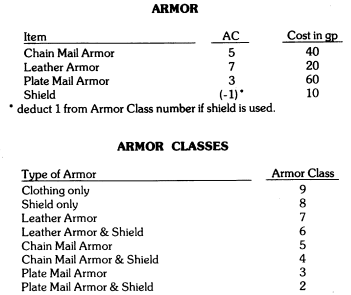
To start with, we’re gonna need the basic AC values from OD&D (I will get into why in a moment), B/X, OSE, and AD&D 1e’s Player’s Handbook. The OD&D values were actually quite hard to find; I couldn’t find an exact match in the Men & Magic book to just tell me if Plate Mail was AC 2 or what. I couldn’t find it quickly detailed in Chainmail or Greyhawk, either, and had to resort to Delving Deeper (I double-checked against Fantastic Medieval Campaigns for accuracy):
Here we see, indeed, that the base unarmoured AC for 1e is 10, rather than B/X and OD&D’s 9. Fine, seems like everyone is right, and we could end it there. But…there needs to be more interrogation.
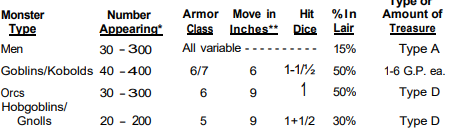
You see, AD&D 1e’s Monster Manual was released in 1977, before the Player’s Handbook and Dungeon Master’s Guide. And I have long heard that the Monster Manual simply reused many of its stats from OD&D, rather than updating them to the AD&D AC standard–indeed, it may be that at the time of the Monster Manual’s publication, the new standard had not even been created yet.
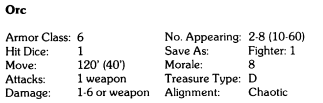
So, we need evidence. Let’s grab orcs. They’re in every edition of the game and we should be able to look at them easy.
Wait. What the fuck? Why are orcs at 6AC still in AD&D? Leather armour is 6 AC in B/X and earlier, but 6 AC in AD&D is studded leather. Are AD&D orcs wearing studded leather? Or perhaps scale mail? Their description offers nothing.
It’s possible the AC values for AD&D are supposed to simply be abstracted–orcs have 6 AC, and it’s up to the DM to determine if this means they have studded leather, ring mail and shield, etc. Hey, who am I to argue?
Some of the monsters just are straight up different, which helps no one.
So, here’s what we’ve figured out: The monsters in the AD&D 1e Monster Manual do in fact conform to OD&D and B/X AC standards. In most cases, where they aren’t changed entirely to something clearly different, they opted to simply leave the AC the same and not bother to “adjust” to what it “should be” according to the new scale. In cases of humanoid men, typically they included a %-based table of what equipment they had; in these cases I assume you were to use the PC-facing armour class table to determine their AC. But an ogre just has AC 5, no matter if this scale is different.
But…this whole thing kicked off because of modules, not because of the AD&D Monster Manual. By my own admission, one needs not look at the AD&D Monster Manual at all, merely what is in the modules. Well, I wanted to do the research, because I need to know: Are the monsters as printed in modules bespoke, or are they simply reprinted from the Monster Manual?
To check this out, we’re gonna start with a couple famous modules that are likely to be rec’d and used in OSE’s format. Let’s start with T1: The Village of Hommlet, and see if we can’t find a few of the baddies we’ve already looked at.
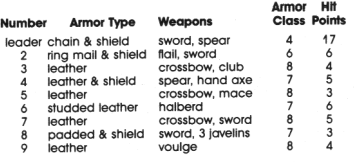
Of first note, there’s some bandits and included is the table of what AC they should have based on their equipment–helpful. Let’s compare these AC against OSE:
So, their AC actually is going off the AD&D PHB, meaning their AC is actually worse than if we just used the proper values for OSE. If you use these values, the bandits will actually be easier to hit than they were in AD&D…maybe. I gotta be real: I’m not an AD&D 1e expert and it’s possible the to hit and STR modifiers are different enough to account for this.
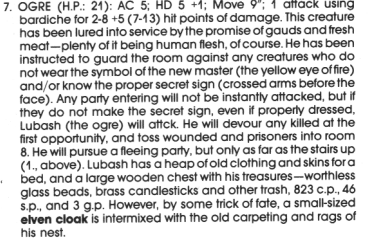
Here’s our ogre friend, with 5 AC as expected. The same as in OSE.
Let’s move on to N1: Against The Cult of the Reptile God, a classic. This has no orcs but it does have goblins:
I could go on with more deep diving into old modules, but based on these two examples, I think it’s safe to say that the standard was to just grab the stats from the Monster Manual and reprint them. So, even less than we’ve thought, do we need to worry about the difference in AC.
I was reading a thread about build options in 5e (I immediately got diarrhea typing that) and someone repeated the common wisdom: “Well, fire is the most resisted damage type in 5e,” and I got pissed off again.
The only reason this is true is because the game has 800 demons and devils, every one of which is resistant or immune to fire damage. If you don’t fight demons or devils, you basically won’t encounter this problem.
I got pushback so I did the work. Here’s the numbers of every official creature in 5e with fire resistance. I’m not covering immunity, as I don’t think it’s as relevant: most categories have no creatures who are immune to fire, and those that do…make sense? (Yeah! Fire elementals are immune to fire damage!) Meanwhile, the numbers I have here do not account for the Volo’s and Mordenkainen’s “Legacy” content; I counted those monsters as one monster because you’re not going to encounter both “versions” in the same game.
So, that leaves us with hard numbers:
Aberration: 15, 10 of which are Slaad and 1 of which is YGORL, LORD OF ENTROPY
Beast: 2: Fiendish Giant Spider, Stench Kow
Celestials: 4, all of which are in setting or adventures
Construct: 7, all of which are in setting or adventures, except for the Sacred Statue possessed by an Eidolon
Dragon: 14, which, they’re dragons.
Elemental: 13, which shouldn’t be surprising as they’re elementals
Fey: 7, 6 of which are in setting or adventures
Giant: 6, 5 of which are CR 20+ titans from Bigby’s
Humanoid: 28, 17 of which are Dragonborn, Tieflings, half-dragons, draconic sorcerers or the Fiendlock
Monstrosity: 3
Ooze: 8, 5 of which are gray ooze variations
Plant: 5
Undead: 35
That means there’s a total of 147 non-Fiend monsters with fire resistance, of which 92 you are realistically going to encounter in your campaign.
In comparison, there are seven pages of fiends with fire resistance in 5e and four pages with immunity. Now, I’m sure some of that is doubled up from the “Legacy” content, I’m not going to dig through and find it. (The fact that I can’t filter out “Legacy” content is a real fuck up on D&D Beyond’s part.) But if we ignore that, that’s 140 Fiends with fire resistance. In other words, fiends take up like 50% of all monsters in the game with fire resistance. More if you ignore all the shit you’re not going to fight (like 5 gray ooze variations).