Thirty and counting.
Connoisseur of fine trash.
Not ever gonna make it,
but then again, who does?

The dice exist to resolve ambiguity.

CATEGORIES

  • Dividing XP by HD

    Gary Gygax was wrong.

    …when he said this.

    After playing in Luke Gearing’s OD&D game for about a year I really began to love the simplicity of making monsters worth 100XP per Hit Die. It’s actually so simple, why did we ever move away from it?

    This is especially true in my games, where my Wizardry, Final Fantasy, Dragon Quest brain equates the primary way you level up to be killing monsters. Gold is, of course, worth more, and I write my material with that assumption and that work, but for my own system? My own games? I need not be 100% beholden to that. I like a fighty D&D game where the players take on big crazy monsters. I have all these fucking monster miniatures for a reason; I’d like to goddamn use them!

    But after a while we sort of started to see the flaw in the 100xp for HD. We were doing a lot of stuff up on Floor 1 of the megadungeon and killing all sorts of guys, some of whom were worth a lot of XP, and we are sort of high level–we’re talking 5, 6, 7th level fighters and magic users here, and with magic items coming out of our ass. It was trivially easy for us to nuke a party of 3HD monsters and move on with our day.

    So the new rule was instituted that The Formula suggested even in OD&D would be used: monster HD x 100 divided by player level or whatever it is. We all rapidly saw Our Gains go down the drain.

    I was never happy with this formula. For one thing the dungeon level doesn’t necessarily equate to what HD the monsters are, so this math really starts to fall apart depending on how much you’re doing outside of that box. For two, it only encourages you to go further into the dungeon, not to fight larger foes.

    Here’s my proposal:

    Each monster is worth a baseline of 100XP per HD. This is thrown into a big pool.

    So the players fight let’s say 5 3HD monsters. 300 x 5 is 1500xp. That’s the pool. Now we look at the players. The party is a 2nd level MU, a 4th level fighter, and a 3rd level thief. What we want to do is compare all of the player HD to the monster HD, and determine what share each player should get. This is the XP Cap of each player. Notably, we do not yet divide XP.

    In this situation, the thief is equal to the monsters’ HD and so is entitled to a full share of XP. The Fighter is at 4:3 and so is entitled to 75%. The Magic User is level 2 and at 2:4 and thus is entitled to 200% share.

    What this means is that each player takes the 500xp they are entitled to and then multiplies by their %. So the MU actually earns up to 1000xp from this encounter. The thief earns 500xp. The Fighter earns only 375xp.

    But wait: that seems like a lot so we need one more step. Each participant takes their XP from the pool from lowest to highest. So the Fighter first earns 375 XP, leaving 1125XP. Now we subtract the Thief’s 500xp leaving only 625 for the magic user. Less than their weighed 1000xp would have been, but still more than they would have earned otherwise.

    What this does is reward fighting a monster bigger than you but not necessarily encourage it as there is an upper limit to how much you’re going to earn. This group of orcs can only ever reward 1500xp. But in this formula, no XP is ever “lost.”

    Of course, this is also a lot of math. So if your party would rather not fuck around with it, you can just go with 100xp per HD. Or, idk, less, like Gary did, which carried over into B/X and AD&D. Maybe he was right after all, or maybe they wanted to discourage fighting by removing it from the XP progression. Who knows.

    (Also we should be adding multipliers based on certain monster special abilities, like 2e, but that’s another topic.)
  • EMOTIONAL STAKES

    Challenge accepted, motherfucker.

    A lot has been written already about Over/Under and it’s small mechanisms. As I said before, the main “action” players can take is to give each other money. And when the only thing you can do is make money, players start to hustle. But I think there’s one other thing you can do, and it kind of goes back to the reaction of the bosses, mod team and GM of the Chokespawn Incursion.

    So, in any traditional TTRPG, stakes are pretty easy to set up. The easiest is: Your character might die. Your character is going into a dangerous dungeon, or a haunted house, or a derelict spaceship, and probably there’s going to be some terrifying goblin or man-faced bat creature or alien abomination with eight mouths that is going to do so much damage that your character no longer has any hit points and will probably die, maybe with no recourse for resurrection. Hey, I don’t want my character to die! I like playing as this character! So, we do what we can to avoid that. No sweat.

    There’s lots of other ways to add stakes. The bad guys get ahold of an NPC the players like and want to save, or a magic cube that can destroy the world, or they have a bunch of money that the players want to rip off. Easy stakes. Five minutes, a GM can make the players invested enough to rigamarole them through some terrifying location with a bunch of silly bullshit they made up for the night.

    Over/Under has none of that.

    One of the problems with all those stakes I just outlined up above, though: it’s very easy to get the party invested in it. It’s very hard to get the party invested in each other.

    A lot of posts from GMs online start with a conundrum: My players won’t “roleplay with each other.” They don’t care about each other’s back stories or motivations. They’re all just sort of slapped together for this adventure I’ve made, but without that adventure, they wouldn’t really have a reason to care about each other.

    Now, this isn’t necessarily a problem to be solved. That’s the usual advice, and it’s basically correct. If the players don’t want to roleplay with each other, you probably shouldn’t force them to do so. They either will or won’t according to what they desire as players, and that’s fine. But.

    Over/Under is made almost exclusively of players roleplaying with each other. Revealing their backstories. Being invested in them. One of the first things I do after a big server-wide event (like last night’s Invasion of the Jovankabots–uhhh more on that later) is go around and check in on everybody. I gotta make sure Lily and Thoss and Noa made it through.

    These are characters who maybe I’ve actually only interacted with them two or three times before one of these events. Before Thoss ended up in the hospital, I interacted with them…twice? Once on a job and once a few days later to shit on their religious epiphany. But then when a technomancer needed to use me as a conduit to sort through Thoss’s memories, to separate their personality from the cybervirus corruption inside their brain? Berwick broke the fuck down crying for the first time in ten years. (Berwick spent those ten years on various spaceships, alone, doing jobs usually reserved for androids.) Berwick called out to his friend Thoss, apologizing for blowing them off, crying out for them to come back to consciousness.

    I met this player like fucking twice!

    But here’s the thing: This kind of relationship between our two characters, in this scene: now we have stakes. We have emotional stakes between us. This is why we’re doing this.

    The word “scene” really started to enter the vocabulary of not just me but multiple other players. The idea that our two (or three or four) characters end up in a little box theater together and we all kind of know how this should go, but also have no fucking idea what’s about to happen, but we all want it to be important, otherwise we wouldn’t be goddamn doing it. We WANT there to be STAKES. And in a game with no hit points, no macguffins, no “monsters” (villains, surely, but no true monsters), the only stakes left are emotional ones.

    That’s why the doomed yuri squad is so popular and why it’s brought the station to the brink of war like three fucking times already. Even though my character is asexual and definitely not interested in any kind of emotional or physical relationship with anyone (he’s not a people person and has asomphosomphobia from the decade alone in space), I as a player am always deeply invested to see anything from these chucklefuck lesbians because it seems like they are constantly having the most emotional moment of any one person’s entire life, this very second. Scenes that might take an entire two hour film to lead up to are happening seemingly every goddamn day between this lesbian polycule and I don’t think it’s possible for a semi-casual player like me to keep track of all of it, so when I catch any of it I’m down to clown with the rest of the server. (Tbh, I think former Union President Sanyang was assassinated purely because of the player’s complete disinterest in the plotline. You can’t be part of this station and not be at least a little invested in the doomed yuri squad.)

    When you give the players no outlet for stakes, they will create them. Emotional stakes are super easy to create when this is all you got, and IMO it’s something we could do to remember.


  • The Chokespawn Incursion

    This is going to be very very very long, so strap in.

    This post is about an incident that occured in Over/Under, a Mothership MMORPG run entirely in Discord. If you don’t care about that, safely ignore this post.

    Over/Under is still ongoing. This post may contain actionable intel. In addition, this is all from my perspective, perception, and mostly publicly-available posts on the server. I may get things wrong or portray things in the wrong light. In this post, I am not doing so as a manipulation tactic or any attempt to push a narrative or agenda. I am simply fallible.

    Ready?

    (more…)

  • I can’t anymore with the undead

    It has been fifty years and I don’t know the difference between a ghoul, a wraith, a wight, a ghost, a spectre.

    I’m done! Fuck this! It’s time to A) figure all of this out and then B) solve them for my own game and setting.

    I do not care how these terms were co-opted by Gary (or Dave, or Rob and Tim or whoever else). I am only interested in figuring out what they are for me, and extrapolating from there.

    (more…)

  • Megadungeon Treasure Generator

    , , ,

    Maybe this is a misnomer. I don’t know! I built it for megadungeons.

    A problem I have when writing a dungeon is that I often have a set amount of gp I want to give out, but just putting a pile of 4000gp in a room is fucking stupid. I need semi-interesting treasure generated, which I can then riff on and make more unique and actually interesting for the players to interact with. (At least as much as any player thinks the treasure is interesting.)

    So I made this on Perchance. You put in a number, and then it generates a treasure hoard that is…well, a little bit over that number. (I couldn’t get it perfect. Sorry. Maybe I’ll go back and fix it up later. Or if you’re a wizard, you can do it and then let me know.)

    I tried to embed it here all fancy-like, but WordPress kept deleting the iFrame I used. (LMK if you know how to fix that.) So instead, here’s the link: https://perchance.org/19lcfg71ts


  • 2d6 Hirelings

    Here’s the simplest hireling system I could imagine, that still did what I needed it to do. I started using this in my play by post OSR game (which started as OSE and, I’m sure, will further mutate the longer it goes on). Hirelings are not Mercenaries, which are noted below.

    Hirelings

    • The party has 2d6 + collective CHA Mod Hirelings among them. This represents that there is a large amount of Dudes with you on the journey.
    • Each Hireling can hold one inventory item in their hands and carry one inventory item. (100 coins take up one space.)
    • This 2d6 is not rolled, unless it actually matters to the situation at hand–instead, it represents that there are “about 6 or 7 guys” with you.
    • The Hirelings generally hang out in an entry chamber or at a camp just outside the Dungeon.
    • Hirelings equal to collective CHA mod (minimum 2) will follow the party into the Dungeon, but will never fight.
    • Hirelings will never be directly targeted by monsters; in the event of a save (dragon breath, etc.) they will always avoid damage.
    • Once the Dungeon has been safely cleared (or a safe path has been made), all Hirelings will enter the dungeon so they can take any treasure etc. home.
    • A Hireling can hold a torch for the party and provide light to the entire room; they can do this while carrying a bundle of torches as backup.
    • If necessary, roll 2d6 to determine a Hireling’s stats across the board.
    • Hirelings do not gain XP and collectively receive a full party member’s share of GP.*

    *(For example, if a party of 4 PCs and a group of Hirelings enter a Dungeon and found 500gp, each PC would earn 100gp and 125xp.)

    Mercenaries

    • Mercenaries are treated as full PCs for XP and GP, or can forego XP gain for an additional fee (50% * Level).
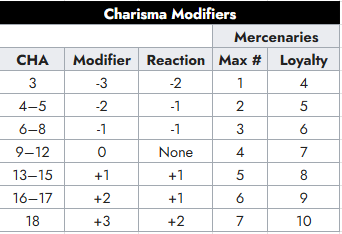
    • The maximum number of Mercenaries you can hire is subject to the “Max # Mercenaries” CHA Mod table.
    • A Mercenary may never be higher level than the party; otherwise, you’d be working for them instead.
    • Mercenaries will obey commands in combat but have their own personalities outside of combat. They do not get a “vote” in terms of party decisions (which path to take, etc.) but will volunteer advice or information if asked.
    • Mistreatment of Mercenaries is subject to a Reaction roll against the Loyalty score (see CHA Mod table). Rolling below this number results in the Mercenary deserting the party.

    For the CHA Mod, use this table below:

    Slowly, the system is forming. MORE SKULLS awaits.


  • B/X XP Table Percentages

    , ,

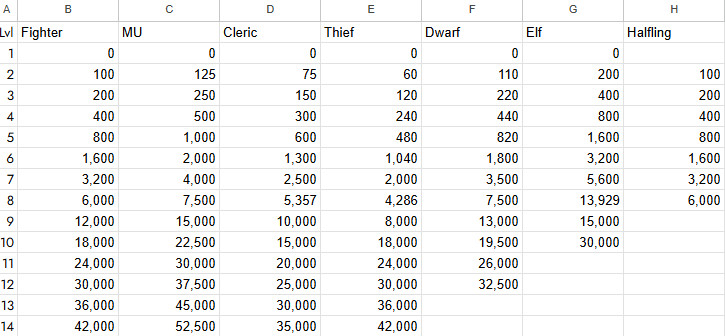
    In earlier editions of D&D, characters level at different rates. A 2nd level Magic User is more powerful than a 2nd level Fighter, and so requires more XP to become level 2. According to the tables, a 2nd level Elf is almost twice as powerful as a 2nd level Fighter.

    I’m not here to argue if this is good design or not or if these numbers are good. I simply wanted to take the XP tables, extract the numbers, and see what percentage each was worth. How much more % XP does a given class require?

    I used the Fighter as the baseline, of course, because they’re even and middle of the pack.

    Might replace this with a table insert later.

    Some of them move around, like the cleric and thief. Others are fairly consistent. But if you wanted a simple modifier, here’s one:

    Magic User: 125%
    Cleric: 75%
    Thief: 60%
    Dwarf: 110%
    Elf: 200%
    Halfling: 100%

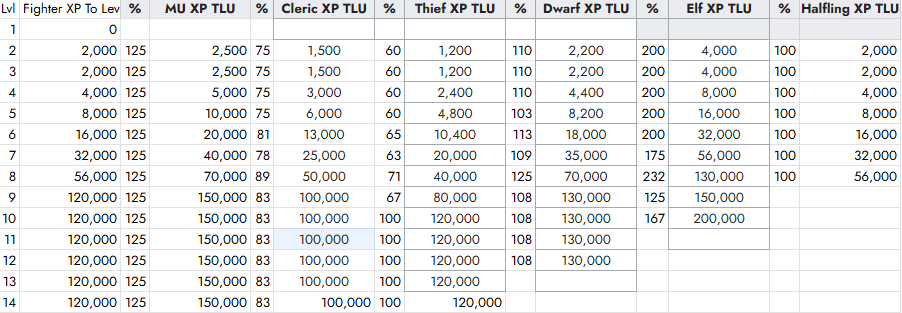
    Using these percentages, you can very easily make your own XP tables. No longer are we chained to the exact progression Gygax made. For example, here’s a fun experiment: Let’s take the 5e XP values (up to level 14), apply them to the Fighter, and extrapolate from there:

    The next step would be, of course, to figure out what percentage the Fighter table is between levels, as it’s mostly variations of doubling. Once we do that, it’s trivial to simply take the amount the Fighter needs to level up to level 2, and from there, we can literally extract the entire level up table. Like so:

    Entire XP tables based off the Fighter needing 100xp to level up to level 2.

    Now, probably shouldn’t be that low, for a proper B/X or OD&D game, especially if you’re using 100xp per HD base for monsters. (In the future this will probably link to an article; I’ve got some words to say!) But, if you’re only awarding XP for gold, or XP in some other fashion where you are as arbitrary as you want to be, maybe these numbers look pretty good?

    Wanna play around with it yourself? Here’s a link to the Google Sheet. Copy for your own reference. Place the XP value to level up to level 2 in cell B3 (the green one) and the entire list will auto-populate. If you’d like more hands-on control of between levels, just put them in column B and the rest will autopopulate.


  • The Pointcrawl vs. The Hexcrawl

    The following post is a cleaned up version of an old Twitter thread.

    THIS is a point crawl map.

    THIS is a hex crawl map.

    Hopefully you are familiar with Super Mario World and Dragon Quest, but if not, I’m sure you have other examples that work and illustrate the point enough to grok the differences. The hexcrawl has to cover objective distance; the point crawl is paths between distinct locations.

    (more…)

  • D&D 2024 Average Monster Type Stats

    Stuff like the Monster Manual On A Business Card is very popular, but I find it just a little too broad. I like monsters to have a little different stats. A demon should be stronger than a humanoid, even if they’re the “same CR” or “same level.” It’s as simple as that. (Obviously, using these stats with “average” stats by CR would mean those stats change a little bit, so ideally I think what happens is you end up wanting to make one generic statblock of each monster type. Maybe that’s where we end up!)

    I made a set of the average monster stats by monster type for 5e 2014 in 2022, but with the release of the 2024 Monster Manual, it’s time to update this. To get these averages, I found someone who had put all the monster stats in a spreadsheet, organized by type, and then averaged them all and rounded to the nearest whole number. I didn’t do any degree of accounting for clear outliers or weird situations, just literally every monster of that type that’s in the book. Under the cut, the new averages:

    (more…)

  • Morale As Reaction

    , ,

    The ‘reaction roll’ is something I’ve always struggled with in OSR games. Putting aside that I come from a more story based, new-school ‘the DM can just decide whatever they want’ philosophy, what it really comes down to is that the table sucks.

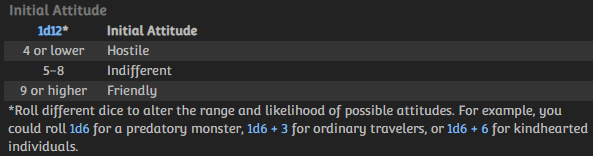
    Various reaction tables from OD&D, OSE, AD&D 1e, 2e, and 5e 2024.

    As I put the final text into layout for Castle Gygar, I’m thinking a lot about how I want to see monster statblocks formatted (and the ridiculous amount of space standard OSE statblocks still take up). One bit has been sticking out to me, the Morale check. Even as I run my play-by-post OSE game, I forget to check it, which means it essentially doesn’t get used. How can we make this number more useful?

    Maybe we should roll it into the reaction rolls. The reaction roll tables are annoying because so much of the table either doesn’t matter or is unclear. Neutral, unsteady reactions don’t really interest me or give me anything to riff on as a DM in many cases. I find it works best if the monster is simply hostile or friendly. A ‘friendly’ monster doesn’t even need to immediately be all buddy-buddy with the party–maybe this is what they mean by neutral, but it never feels that way to me.

    The easiest thing to do is simply say that a positive reaction roll is any that exceeds the Morale score. You meet a new monster or group of monsters, you check morale. You can even adjust this for Charisma. It’s almost brilliant enough to work?

    It might break down with certain big ass boss monster NPCs who you also want to be friendly. For example a Red Dragon’s got 10 morale, so you need to hit 10-12+ to get it to even talk to you. But again, there’s always the adjustment, and of course the DM Fiat. Remember: the dice exist to resolve ambiguity, not infer reality.

    I’m gonna try it out. Worst thing that happens is it sucks!


  • The 1973 Original Dungeons & Dragons Draft

    In January 1974, the original Dungeons & Dragons box set was released. Often this is referred to as OD&D or the “3 little brown booklets.” Much has been said about this, including multiple retroclones (like Delving Deeper and Fantastic Medieval Campaigns).

    During Dave Arneson’s lawsuit against Gary Gygax and TSR, a 1973 draft of the game was submitted as evidence. It stayed buried in the archives of the case for nearly 50 years before it was unearthed by a variety of people. Now it’s available for anyone to read.

    I had a hard time finding a link to this draft in a lot of the blog posts that talked about it, so here’s a link to the PDF:
    https://drive.google.com/file/d/1gwiPJSxQEX6ozSluhi4RWRmGfM-HWN0u/view?usp=sharing

    I won’t be going over it today, but here’s Arneson’s response:
    https://drive.google.com/file/d/1gtojjrlTywMjKW7T-qjlm8vh8qVpxVCY/view?usp=sharing

    But, I’m going to look at it today, because I’m a crazy person with a lot of time on my hands. And I’m going to post the interesting shit I find. Let’s ride.

    (more…)

  • The Public Domain Statement

    I believe copyright is a sham.

    I believe that lobbying corporations have turned what was originally a protection designed for the individual artist into a strangehold over ideas and culture in America, and by extention the rest of the world.

    Copyright existed so that I could make a work of art, and then for a reasonable amount of time after that, profit from that art. I am not directly opposed to this idea. In fact, I think it’s a great idea. A creator of something should have, for at least a while, the exclusive right to create and distribute their work and profit from it. And by profit, I really mean, “make a living from.”

    Which is where my next bit comes in: The original terms for copyright were seven years from the original date of publication. Which means I make a book, or a painting, or a song, and for seven years, that’s Mine. You can’t reprint it or alter it without my permission. But then, seven years later, it’s free game. You have had seven years to profit and make a living from this single work of art; time’s up, better get back to those artin’ mines and make a second thing.

    The intent for this was twofold: It prevented one artist from relying on a single work for their entire livelihood, forcing one to create Again. And I philosophically believe that not just the art of creation is good for the human soul, but continued creation of art is good for the human soul. I made a lot of music before, I’ve made TTRPGs before, but nothing heals my soul after the long week of capitalist bullshit than sitting down and making something entirely new.

    Secondly, it prevents one from monopolising the culture. If a creation became so widespread and popular, it becomes part of the culture. It BECOMES PART OF THE CULTURE. The olden Gods like Zeus and Thor are part of the culture. The myths of older cultures are part of the culture. King Arthur and the Knights of the Round Table are part of the culture. Robin Hood, Peter Pan, Cinderella, Beowulf, all of these are part of our culture.

    So are Superman, Batman, Spiderman, Mickey Mouse, Pikachu. These characters are also a part of our culture. And we should be able to interpret them as we like, without threat of corporations stomping us down.

    I am under no illusion that anything we create for Tidal Wave Games could be as popular as those things. But, they could become popular. People may want to build on our ideas, whether they be mechanical game design or worldbuilding. Therefore, we want them to be accessible to the culture–after, of course, a reasonable amount of time has passed.

    Those who picked up CERES: THE PLANET THAT NEVER SLEEPS may have noted a piece of text in the table of contents & credits page: “All text contained within this book will become public domain on January 1st, 2033.” That is a legally binding statement, and it’s true. As of January 1st, 2033, all the text in Ceres will be public domain and anyone can use it or build upon it without attribution. As of the 4th printing of the CUSC Core Rulebook coming early next year, it will contain the same text, with a revised date of 2032–ten years after original publication.

    This is our commitment, to the culture of the world. We hold on to the copyright for ten years. You can do whatever you want after that. The art, is not public domain, because we are against the AI image war and we are pretty concerned about what letting our images into the public domain might do for that, among other things. But, we aren’t going to come after you for making new art based on those images–reinterpret the world as you see fit, fan artists!

    Furthermore, if you’re interested in working with some of our content or want to make stuff based on it–just talk to me. We are extremely open and want people to create for us. We’ll even pay you and help you put it out!


  • Cereal Box Hexcrawl

    I was at my day job grocery shopping about two months ago when, on the back of a store brand Cheerios box, there was a hexcrawl.

    image

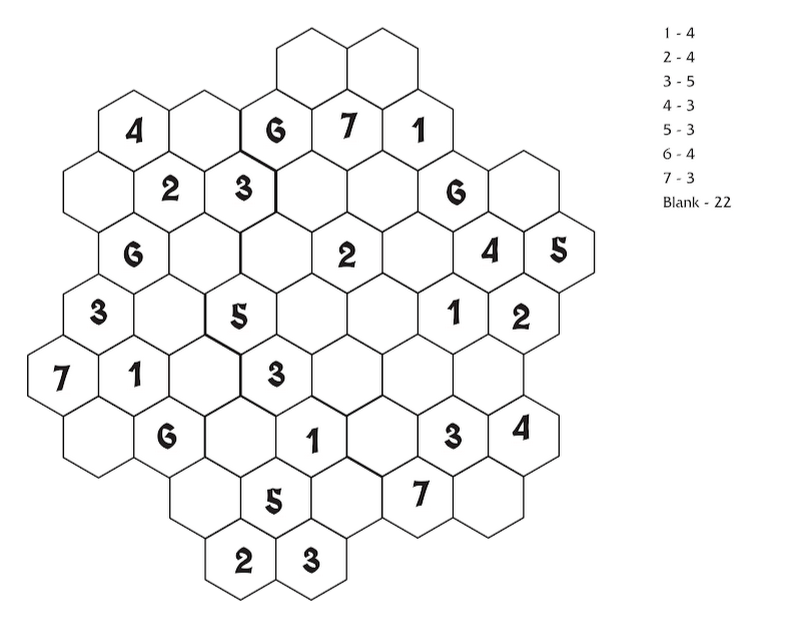
    Okay, the box says it’s a sudoku puzzle. I don’t know shit about sudoku. It’s a hexcrawl now.

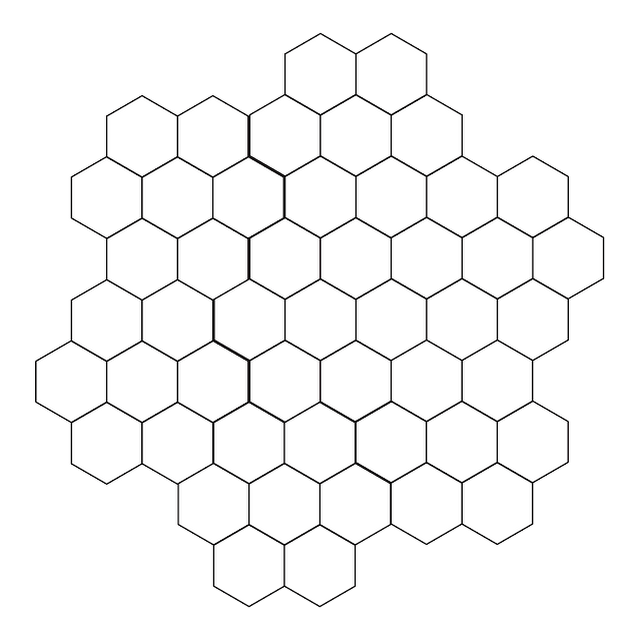
    The first thing I did was recreate the hexcrawl in Affinity Publisher. You could do this with any graphic editing software or even by hand on paper, I just used what I’m comfortable with. I counted how many of each number and wrote it on the side; I also created a blank template that you can use.

    image
    image

    I left the “region borders” out of mine because I felt like they restricted the creativity too much, but you can add them back in.

    image

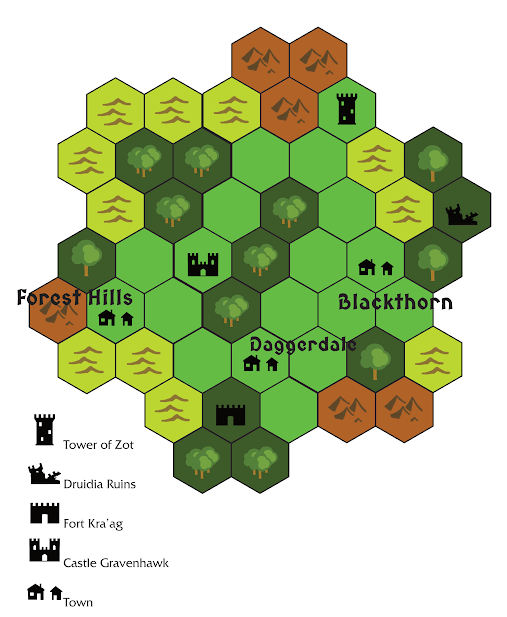
    The next step is to colour the hexes. I assumed we would need towns, dungeons, forest, hills and mountains, so I grouped them together based on what felt right and how many I had of each. I then split up the blank tiles based on mostly grasslands but went with what was around.

    image

    Lastly, I added icons from Hexographer. I named some evocative dungeon locations, some crap 5 minute town names, and boom–we have an adventuring location ready for play. This took about an hour and most of that was graphic design!

    The icon packs I used are here:
    https://welshpiper.com/packages/classic-hexographer-icons/?sfw=pass1685689538
    https://www.hexographer.com/extra-icon-sets/multicolored-classic/

    So, fine, I made a local area. But, my wife is also running a Spelljammer campaign, and needed her own local area. To the rescue: The Cereal Hexcrawl.

    image

    We named a few areas and generated some interesting locations using the tables found in Stars Over Stormwreck by Mike Shea of Sly Flourish. I can’t believe this kind of stuff wasn’t in any of the books for Spelljammer!

    After we had our locations, we just spread them out based on the numbers we had on our hex map. We might have moved a couple around. Then, I opened my hexcrawl up in Affinity Publisher and did the work doing graphic design (including the space background). I’ve got a print copy of the map on 11×17 paper coming from Printkeg right now!

    Protip: If you are doing a space hexcrawl or other kind of space map, for personal use, Googling “planet clip art” or other things like that is a GREAT resource. High resolution transparent background graphic representations of planets? Gimme that shit!

    So you can see how easy this is to pull off. I made my original hexcrawl in about an hour over my lunch break, and that includes finding all the icons and stuff. It’s so easy to come up with a local area from this and the iterations and changes you could make are seemingly infinite.

    Get out there and make your hexcrawl!