Thirty and counting.
Connoisseur of fine trash.
Not ever gonna make it,
but then again, who does?

The dice exist to resolve ambiguity.


GOOD POSTS:

  • D&D 2024 Average Monster Type Stats

    Stuff like the Monster Manual On A Business Card is very popular, but I find it just a little too broad. I like monsters to have a little different stats. A demon should be stronger than a humanoid, even if they’re the “same CR” or “same level.” It’s as simple as that. (Obviously, using these stats with “average” stats by CR would mean those stats change a little bit, so ideally I think what happens is you end up wanting to make one generic statblock of each monster type. Maybe that’s where we end up!)

    I made a set of the average monster stats by monster type for 5e 2014 in 2022, but with the release of the 2024 Monster Manual, it’s time to update this. To get these averages, I found someone who had put all the monster stats in a spreadsheet, organized by type, and then averaged them all and rounded to the nearest whole number. I didn’t do any degree of accounting for clear outliers or weird situations, just literally every monster of that type that’s in the book. Under the cut, the new averages:

    (more…)

  • Morale As Reaction

    , ,

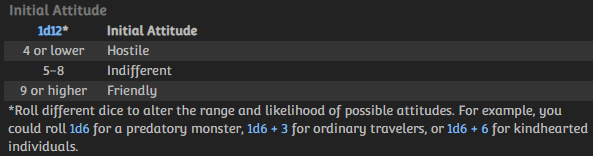
    The ‘reaction roll’ is something I’ve always struggled with in OSR games. Putting aside that I come from a more story based, new-school ‘the DM can just decide whatever they want’ philosophy, what it really comes down to is that the table sucks.

    Various reaction tables from OD&D, OSE, AD&D 1e, 2e, and 5e 2024.

    As I put the final text into layout for Castle Gygar, I’m thinking a lot about how I want to see monster statblocks formatted (and the ridiculous amount of space standard OSE statblocks still take up). One bit has been sticking out to me, the Morale check. Even as I run my play-by-post OSE game, I forget to check it, which means it essentially doesn’t get used. How can we make this number more useful?

    Maybe we should roll it into the reaction rolls. The reaction roll tables are annoying because so much of the table either doesn’t matter or is unclear. Neutral, unsteady reactions don’t really interest me or give me anything to riff on as a DM in many cases. I find it works best if the monster is simply hostile or friendly. A ‘friendly’ monster doesn’t even need to immediately be all buddy-buddy with the party–maybe this is what they mean by neutral, but it never feels that way to me.

    The easiest thing to do is simply say that a positive reaction roll is any that exceeds the Morale score. You meet a new monster or group of monsters, you check morale. You can even adjust this for Charisma. It’s almost brilliant enough to work?

    It might break down with certain big ass boss monster NPCs who you also want to be friendly. For example a Red Dragon’s got 10 morale, so you need to hit 10-12+ to get it to even talk to you. But again, there’s always the adjustment, and of course the DM Fiat. Remember: the dice exist to resolve ambiguity, not infer reality.

    I’m gonna try it out. Worst thing that happens is it sucks!


  • The 1973 Original Dungeons & Dragons Draft

    In January 1974, the original Dungeons & Dragons box set was released. Often this is referred to as OD&D or the “3 little brown booklets.” Much has been said about this, including multiple retroclones (like Delving Deeper and Fantastic Medieval Campaigns).

    During Dave Arneson’s lawsuit against Gary Gygax and TSR, a 1973 draft of the game was submitted as evidence. It stayed buried in the archives of the case for nearly 50 years before it was unearthed by a variety of people. Now it’s available for anyone to read.

    I had a hard time finding a link to this draft in a lot of the blog posts that talked about it, so here’s a link to the PDF:
    https://drive.google.com/file/d/1gwiPJSxQEX6ozSluhi4RWRmGfM-HWN0u/view?usp=sharing

    I won’t be going over it today, but here’s Arneson’s response:
    https://drive.google.com/file/d/1gtojjrlTywMjKW7T-qjlm8vh8qVpxVCY/view?usp=sharing

    But, I’m going to look at it today, because I’m a crazy person with a lot of time on my hands. And I’m going to post the interesting shit I find. Let’s ride.

    (more…)

  • The Public Domain Statement

    I believe copyright is a sham.

    I believe that lobbying corporations have turned what was originally a protection designed for the individual artist into a strangehold over ideas and culture in America, and by extention the rest of the world.

    Copyright existed so that I could make a work of art, and then for a reasonable amount of time after that, profit from that art. I am not directly opposed to this idea. In fact, I think it’s a great idea. A creator of something should have, for at least a while, the exclusive right to create and distribute their work and profit from it. And by profit, I really mean, “make a living from.”

    Which is where my next bit comes in: The original terms for copyright were seven years from the original date of publication. Which means I make a book, or a painting, or a song, and for seven years, that’s Mine. You can’t reprint it or alter it without my permission. But then, seven years later, it’s free game. You have had seven years to profit and make a living from this single work of art; time’s up, better get back to those artin’ mines and make a second thing.

    The intent for this was twofold: It prevented one artist from relying on a single work for their entire livelihood, forcing one to create Again. And I philosophically believe that not just the art of creation is good for the human soul, but continued creation of art is good for the human soul. I made a lot of music before, I’ve made TTRPGs before, but nothing heals my soul after the long week of capitalist bullshit than sitting down and making something entirely new.

    Secondly, it prevents one from monopolising the culture. If a creation became so widespread and popular, it becomes part of the culture. It BECOMES PART OF THE CULTURE. The olden Gods like Zeus and Thor are part of the culture. The myths of older cultures are part of the culture. King Arthur and the Knights of the Round Table are part of the culture. Robin Hood, Peter Pan, Cinderella, Beowulf, all of these are part of our culture.

    So are Superman, Batman, Spiderman, Mickey Mouse, Pikachu. These characters are also a part of our culture. And we should be able to interpret them as we like, without threat of corporations stomping us down.

    I am under no illusion that anything we create for Tidal Wave Games could be as popular as those things. But, they could become popular. People may want to build on our ideas, whether they be mechanical game design or worldbuilding. Therefore, we want them to be accessible to the culture–after, of course, a reasonable amount of time has passed.

    Those who picked up CERES: THE PLANET THAT NEVER SLEEPS may have noted a piece of text in the table of contents & credits page: “All text contained within this book will become public domain on January 1st, 2033.” That is a legally binding statement, and it’s true. As of January 1st, 2033, all the text in Ceres will be public domain and anyone can use it or build upon it without attribution. As of the 4th printing of the CUSC Core Rulebook coming early next year, it will contain the same text, with a revised date of 2032–ten years after original publication.

    This is our commitment, to the culture of the world. We hold on to the copyright for ten years. You can do whatever you want after that. The art, is not public domain, because we are against the AI image war and we are pretty concerned about what letting our images into the public domain might do for that, among other things. But, we aren’t going to come after you for making new art based on those images–reinterpret the world as you see fit, fan artists!

    Furthermore, if you’re interested in working with some of our content or want to make stuff based on it–just talk to me. We are extremely open and want people to create for us. We’ll even pay you and help you put it out!


  • Cereal Box Hexcrawl

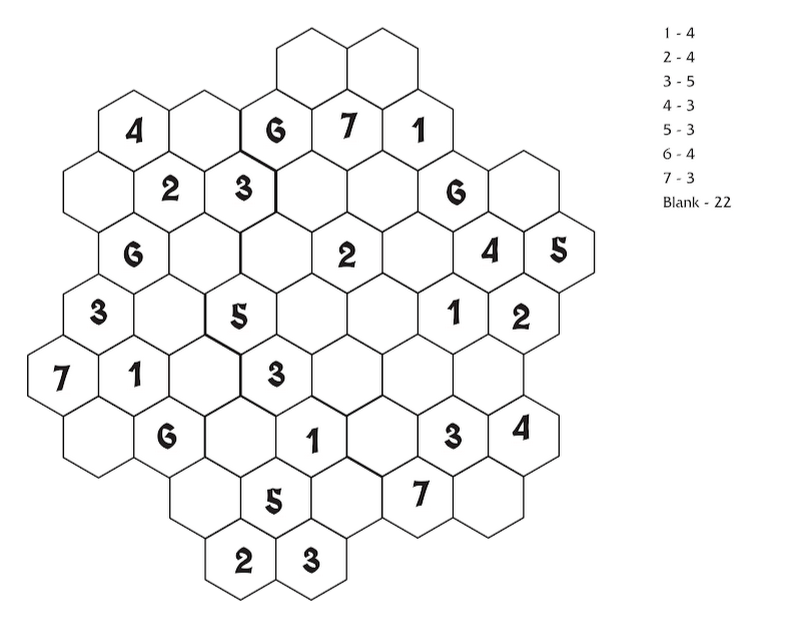
    I was at my day job grocery shopping about two months ago when, on the back of a store brand Cheerios box, there was a hexcrawl.

    image

    Okay, the box says it’s a sudoku puzzle. I don’t know shit about sudoku. It’s a hexcrawl now.

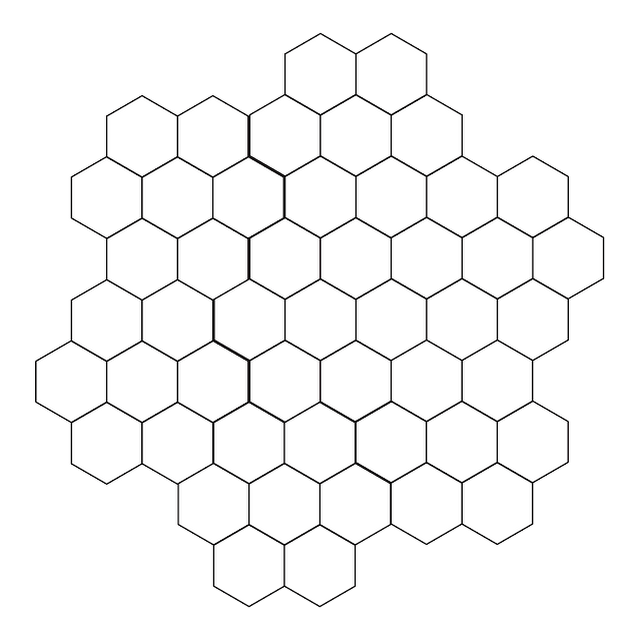
    The first thing I did was recreate the hexcrawl in Affinity Publisher. You could do this with any graphic editing software or even by hand on paper, I just used what I’m comfortable with. I counted how many of each number and wrote it on the side; I also created a blank template that you can use.

    image
    image

    I left the “region borders” out of mine because I felt like they restricted the creativity too much, but you can add them back in.

    image

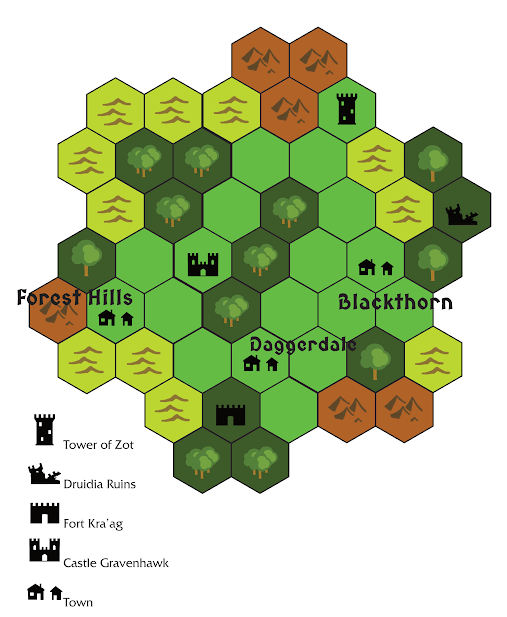
    The next step is to colour the hexes. I assumed we would need towns, dungeons, forest, hills and mountains, so I grouped them together based on what felt right and how many I had of each. I then split up the blank tiles based on mostly grasslands but went with what was around.

    image

    Lastly, I added icons from Hexographer. I named some evocative dungeon locations, some crap 5 minute town names, and boom–we have an adventuring location ready for play. This took about an hour and most of that was graphic design!

    The icon packs I used are here:
    https://welshpiper.com/packages/classic-hexographer-icons/?sfw=pass1685689538
    https://www.hexographer.com/extra-icon-sets/multicolored-classic/

    So, fine, I made a local area. But, my wife is also running a Spelljammer campaign, and needed her own local area. To the rescue: The Cereal Hexcrawl.

    image

    We named a few areas and generated some interesting locations using the tables found in Stars Over Stormwreck by Mike Shea of Sly Flourish. I can’t believe this kind of stuff wasn’t in any of the books for Spelljammer!

    After we had our locations, we just spread them out based on the numbers we had on our hex map. We might have moved a couple around. Then, I opened my hexcrawl up in Affinity Publisher and did the work doing graphic design (including the space background). I’ve got a print copy of the map on 11×17 paper coming from Printkeg right now!

    Protip: If you are doing a space hexcrawl or other kind of space map, for personal use, Googling “planet clip art” or other things like that is a GREAT resource. High resolution transparent background graphic representations of planets? Gimme that shit!

    So you can see how easy this is to pull off. I made my original hexcrawl in about an hour over my lunch break, and that includes finding all the icons and stuff. It’s so easy to come up with a local area from this and the iterations and changes you could make are seemingly infinite.

    Get out there and make your hexcrawl!