This is going to be very very very long, so strap in.
This post is about an incident that occured in Over/Under, a Mothership MMORPG run entirely in Discord. If you don’t care about that, safely ignore this post.
Over/Under is still ongoing. This post may contain actionable intel. In addition, this is all from my perspective, perception, and mostly publicly-available posts on the server. I may get things wrong or portray things in the wrong light. In this post, I am not doing so as a manipulation tactic or any attempt to push a narrative or agenda. I am simply fallible.
It has been fifty years and I don’t know the difference between a ghoul, a wraith, a wight, a ghost, a spectre.
I’m done! Fuck this! It’s time to A) figure all of this out and then B) solve them for my own game and setting.
I do not care how these terms were co-opted by Gary (or Dave, or Rob and Tim or whoever else). I am only interested in figuring out what they are for me, and extrapolating from there.
Maybe this is a misnomer. I don’t know! I built it for megadungeons.
A problem I have when writing a dungeon is that I often have a set amount of gp I want to give out, but just putting a pile of 4000gp in a room is fucking stupid. I need semi-interesting treasure generated, which I can then riff on and make more unique and actually interesting for the players to interact with. (At least as much as any player thinks the treasure is interesting.)
So I made this on Perchance. You put in a number, and then it generates a treasure hoard that is…well, a little bit over that number. (I couldn’t get it perfect. Sorry. Maybe I’ll go back and fix it up later. Or if you’re a wizard, you can do it and then let me know.)
I tried to embed it here all fancy-like, but WordPress kept deleting the iFrame I used. (LMK if you know how to fix that.) So instead, here’s the link: https://perchance.org/19lcfg71ts
Here’s the simplest hireling system I could imagine, that still did what I needed it to do. I started using this in my play by post OSR game (which started as OSE and, I’m sure, will further mutate the longer it goes on). Hirelings are not Mercenaries, which are noted below.
Hirelings
The party has 2d6 + collective CHA Mod Hirelings among them. This represents that there is a large amount of Dudes with you on the journey.
Each Hireling can hold one inventory item in their hands and carry one inventory item. (100 coins take up one space.)
This 2d6 is not rolled, unless it actually matters to the situation at hand–instead, it represents that there are “about 6 or 7 guys” with you.
The Hirelings generally hang out in an entry chamber or at a camp just outside the Dungeon.
Hirelings equal to collective CHA mod (minimum 2) will follow the party into the Dungeon, but will never fight.
Hirelings will never be directly targeted by monsters; in the event of a save (dragon breath, etc.) they will always avoid damage.
Once the Dungeon has been safely cleared (or a safe path has been made), all Hirelings will enter the dungeon so they can take any treasure etc. home.
A Hireling can hold a torch for the party and provide light to the entire room; they can do this while carrying a bundle of torches as backup.
If necessary, roll 2d6 to determine a Hireling’s stats across the board.
Hirelings do not gain XP and collectively receive a full party member’s share of GP.*
*(For example, if a party of 4 PCs and a group of Hirelings enter a Dungeon and found 500gp, each PC would earn 100gp and 125xp.)
Mercenaries
Mercenaries are treated as full PCs for XP and GP, or can forego XP gain for an additional fee (50% * Level).
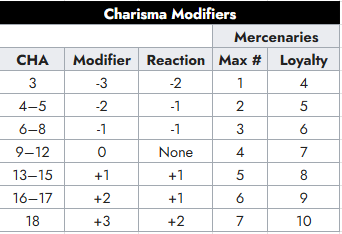
The maximum number of Mercenaries you can hire is subject to the “Max # Mercenaries” CHA Mod table.
A Mercenary may never be higher level than the party; otherwise, you’d be working for them instead.
Mercenaries will obey commands in combat but have their own personalities outside of combat. They do not get a “vote” in terms of party decisions (which path to take, etc.) but will volunteer advice or information if asked.
Mistreatment of Mercenaries is subject to a Reaction roll against the Loyalty score (see CHA Mod table). Rolling below this number results in the Mercenary deserting the party.
For the CHA Mod, use this table below:
Slowly, the system is forming. MORE SKULLS awaits.
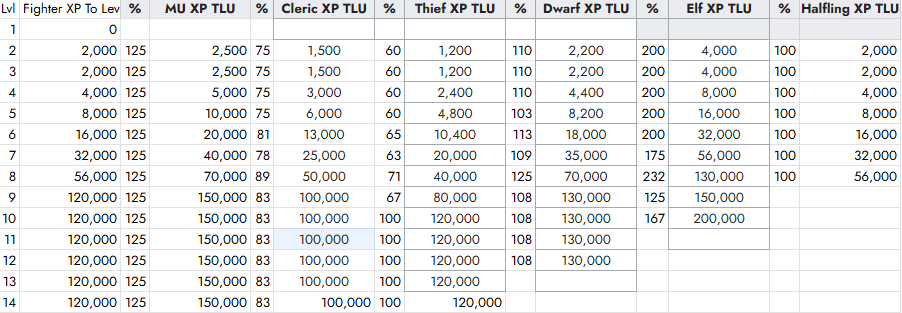
In earlier editions of D&D, characters level at different rates. A 2nd level Magic User is more powerful than a 2nd level Fighter, and so requires more XP to become level 2. According to the tables, a 2nd level Elf is almost twice as powerful as a 2nd level Fighter.
I’m not here to argue if this is good design or not or if these numbers are good. I simply wanted to take the XP tables, extract the numbers, and see what percentage each was worth. How much more % XP does a given class require?
I used the Fighter as the baseline, of course, because they’re even and middle of the pack.
Might replace this with a table insert later.
Some of them move around, like the cleric and thief. Others are fairly consistent. But if you wanted a simple modifier, here’s one:
Using these percentages, you can very easily make your own XP tables. No longer are we chained to the exact progression Gygax made. For example, here’s a fun experiment: Let’s take the 5e XP values (up to level 14), apply them to the Fighter, and extrapolate from there:
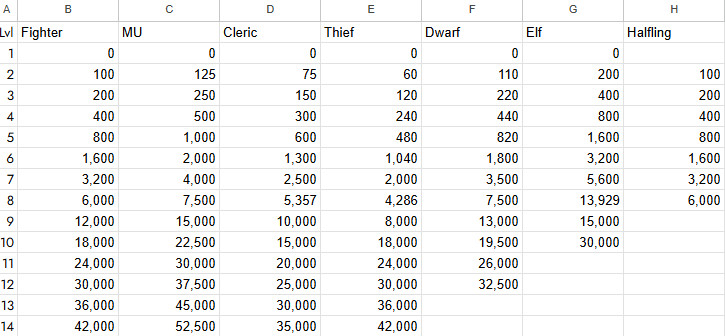
The next step would be, of course, to figure out what percentage the Fighter table is between levels, as it’s mostly variations of doubling. Once we do that, it’s trivial to simply take the amount the Fighter needs to level up to level 2, and from there, we can literally extract the entire level up table. Like so:
Entire XP tables based off the Fighter needing 100xp to level up to level 2.
Now, probably shouldn’t be that low, for a proper B/X or OD&D game, especially if you’re using 100xp per HD base for monsters. (In the future this will probably link to an article; I’ve got some words to say!) But, if you’re only awarding XP for gold, or XP in some other fashion where you are as arbitrary as you want to be, maybe these numbers look pretty good?
Wanna play around with it yourself? Here’s a link to the Google Sheet. Copy for your own reference. Place the XP value to level up to level 2 in cell B3 (the green one) and the entire list will auto-populate. If you’d like more hands-on control of between levels, just put them in column B and the rest will autopopulate.