Thirty and counting.
Connoisseur of fine trash.
Not ever gonna make it,
but then again, who does?

The dice exist to resolve ambiguity.


GOOD POSTS:

  • Overloading The Treasure Die

    , ,

    Inspired by Prismatic Wasteland’s Overloading the Encounter Die
    Also inspired by tables from Maze Rats
    Also initially inspired by the loot table in &&&&&&&&& Treasure by Luke Gearing, though all work from that has disappeared from this version.

    I hate rolling up treasure hoards. I’ve never found a good way to do it, either quickly or efficiently. It is the bane of my prep, the bane of my games. Once there is just a general description of some treasure, I can expand on that improvisationally–but coming up with that initial spark is very difficult for me. So, I did the work, and came up with a way to roll this shit up very quickly. You need 3d6 and the monster’s number of hit die, and these tables. (You can also make your own tables. Have fun!)

    This is best used during prep of a dungeon, focused around a hoard belonging to a specific creature or faction, or at-the-table for random lairs (such as finding a “% in lair” monster). It is not particularly useful for on-hand individual monster treasure (as it’s too involved and not fast enough at the table).

    (more…)

  • Encounter Chains

    ,

    The best thing I ever did for my big-ass hexcrawls was establish what I call “encounter chains.” This is a series of escalating encounters with the same faction or NPC.

    For example, a roving band of orc cultists cutting off people’s left hands. (I can’t take credit for this idea, it’s a riff on this.) The first encounter in this chain actually isn’t the orcs at all, but the result of one of their attacks–an upturned cart and a family of five (man, woman, three children), with the father’s left hand cut off and taken by the orcs. This is a fantastic non-combat encounter that lets you drop info about the orc cult and lets the players figure out all sorts of stuff–turn the cart back over, collect their scattered remaining supplies, offer some of their own, calm down the children, potentially healing magic on the father to at least stop the bleeding and cauterize the wound. Great stuff.

    Then, the next time they find the orcs attempting to knock over another cart. This time the players can stop it. Whether any survive or not, the orcs will be aware that some group of assholes is going around cutting up their cult members, leading to the next encounter where the orcs have definitely set up an ambush for the players.

    Eventually, of course, this all has to lead back to the players asking an orc who they’re with, where they live, what their goal is, and now there’s an orc lair on the map somewhere and the players will be figuring out how to lay siege on it.

    Now, do this for three or four other things. For example: A guy who keeps ending up in mischievous trouble. Buried up to his neck in the middle of the road, enchanted by a satyr and strung up in a tree, stuck in a barrel in the river. Eventually this guy could be revealed to be a powerful NPC ally in disguise as a schmuck to throw people off his scent; a spy from a powerful organization, sent to deal with the same problems the PCs are dealing with (such as our orc cult).

    Other simple examples: A group of roving barbarians, trying to summon a thunder goddess to cleanse the land. A migrating group of treants. An old man, with one eye, attended to by seven canaries, who turns out to be Bahamut, or Odin. A hungry dragon driven from its lair by evil adventurers. Etc. Be creative. Use whatever stuff you like. You can even pull the plotlines and factions from your favourite modules and drop them in, creating the powder keg effect (article forthcoming).

    Once you have three or four of these encounter chains set up, scatter them on your table amongst other, single-service encounters–some just straight up combat (there’s a bulette! attack/run!), some avoidable (an Ettin is in a field looking for easy hunting prey), some unrelated people (like merchants or lost travellers).

    Keeping an even keel between “random bullshit” and “ongoing plot threads” means the game never feels stale, and the players are never overwhelmed by too many threads to keep track of. I don’t recommend any more than four encounter chains at once; any more than that and the players could start to get overwhelmed by ongoing plot threads. It also helps if each encounter chain has a different amount of encounters in them–one chain that can be “solved” in three encounters, one that’s six or seven, one that’s about four. You can alter this based on the vibe of your table and campaign; if you had an encounter chain with five or six encounters and the players are clearly beginning to get annoyed, just jump to the end.

    One thing to keep in mind is that you don’t have to develop every encounter in the chain at the beginning of your prep. You just need the first encounter. Once the players hit upon it, cross it off the encounter list and repopulate it with the next encounter between sessions. Easy money. You can also take any random encounter you’ve used and then decide after the fact to expand on it; maybe you introduce a merchant NPC and play him a little weirdly, and the players are interested and start speculating. Great opportunity to take that guy and turn him into an encounter chain!


  • Morale As Reaction

    , ,

    The ‘reaction roll’ is something I’ve always struggled with in OSR games. Putting aside that I come from a more story based, new-school ‘the DM can just decide whatever they want’ philosophy, what it really comes down to is that the table sucks.

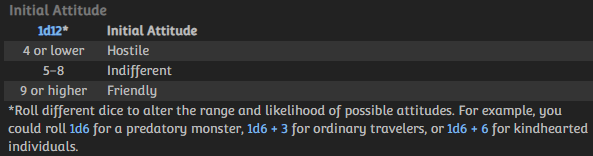
    Various reaction tables from OD&D, OSE, AD&D 1e, 2e, and 5e 2024.

    As I put the final text into layout for Castle Gygar, I’m thinking a lot about how I want to see monster statblocks formatted (and the ridiculous amount of space standard OSE statblocks still take up). One bit has been sticking out to me, the Morale check. Even as I run my play-by-post OSE game, I forget to check it, which means it essentially doesn’t get used. How can we make this number more useful?

    Maybe we should roll it into the reaction rolls. The reaction roll tables are annoying because so much of the table either doesn’t matter or is unclear. Neutral, unsteady reactions don’t really interest me or give me anything to riff on as a DM in many cases. I find it works best if the monster is simply hostile or friendly. A ‘friendly’ monster doesn’t even need to immediately be all buddy-buddy with the party–maybe this is what they mean by neutral, but it never feels that way to me.

    The easiest thing to do is simply say that a positive reaction roll is any that exceeds the Morale score. You meet a new monster or group of monsters, you check morale. You can even adjust this for Charisma. It’s almost brilliant enough to work?

    It might break down with certain big ass boss monster NPCs who you also want to be friendly. For example a Red Dragon’s got 10 morale, so you need to hit 10-12+ to get it to even talk to you. But again, there’s always the adjustment, and of course the DM Fiat. Remember: the dice exist to resolve ambiguity, not infer reality.

    I’m gonna try it out. Worst thing that happens is it sucks!


  • Heartbreaker vs. Craphack

    ,

    The difference between a heartbreaker and a craphack is, you think a heartbreaker will be finished.

    I started using the word “craphack” a few months ago to talk about my in-progress fantasy d20 elfgame. (This is a separate project from CRAWL, which has entered a process of hibernation. Its no longer in active development.)

    I had a lot of names for this thing. It really started when the OGL shit hit the fan and I was already seeing how affordable low-run booklet prints were. The idea of creating a booklet with a bunch of my house rules and favourite tables, and getting it printed, became a kind of cool idea. Simultaneously, WotC quickly jettisoned a bunch of the coolest ideas for 5e 2024. Initially I was like: well, let’s compile those ideas and I’ll make a home game out of what I liked.

    I called this document 5e Killer. This stems from a phrase I said in early 2023: If you are a major TTRPG publisher and you aren’t already working on your 5e Killer for release in Fall 2024, you’re fucking up.

    I am not a major TTRPG publisher. But why not do my own? At least for my home game.

    (more…)

  • Hit Dice, Hit Points & Weapon Damage: Part 2

    ,

    Last October I was talking about Hit Dice, Hit Points & Weapon Damage in my various games, and how I want to work to unify some of this.

    Since that post I’ve thought a lot and want to move forward with things it does, and this required a few changes. First up, I recategorized the classes:

    image

    Couple things: I will be adding a feat that allows you to bump your Hit Die to the next die up (maximum of d12). I like feats in my games! I think big chunky complex games like what else should have lots of customization options.

    Under this system, your hit die is also your hit die, as in the die you roll for damage. Your character does damage, not your weapon. That’s not to say weapons won’t have differences; I am much more strictly implementing a “light/medium/heavy” system and locking those weapons behind class proficiencies. I prefer light/medium/heavy to the 3e “simple/martial” divide; it just makes more sense to me.

    For equipment I’ll be starting with my Canonical Weapons List. I really like this one as it simplifies the list just enough. Probably, I will deep dive into the Martial Options I’ve got for my 5e house rules and compare against the Wolves weapons. (I keep going back but then stopping for some reason. It obviously works in that game or in OD&D. Why am I so hesitant here?)

    But, the first thing I’ve got to cut from the weapons list is the damage. And once that’s done, there’s a little bit of work to be done to ensure an “archetype” exists for each one–there’s 3 damage types, so if there’s a heavy weapon there needs to be 3 of them, one for each type.

    Light weapons will be disadvantage on damage (roll 2, take the lowest) while Heavy weapons will be advantage or when you take the weapon, you can increase it from your Hit Die up one step (maximum of d12).

    Still working on the magic system. I have always liked the way 5e does saves and so I’ll be sticking to that, but I am thinking of changing the way they are statted. I think this version of my game is removing “proficiency bonus” the way it works in 5e. You’ll still have a base attack bonus that increases with level, but skills are moving to a skill ranks system ala 3e, and saves are probably going to use the New Modifiers system.

    And, two house rules that I’ve been using for a while now that are going to stay: Hit Points are your Hit Die plus your CON Score (no modifiers ever added) and Stats are 1d6+8 six times, assign as desired.

    The first thing I’m going to wholly design for this is probably the Barbarian, because I have an interesting and new take on it.