Thirty and counting.
Connoisseur of fine trash.
Not ever gonna make it,
but then again, who does?

The dice exist to resolve ambiguity.


GOOD POSTS:

  • XP Per Room

    One thing I wanted when I revamped the original draft of Ruins of Castle Gygar for OSE was to make sure there was enough treasure to get to level 9. Level 9 is “name level,” the level when all classes officially become “their class.” (Up until level 9, a fighter isn’t even a fighter, they’re all sorts of other things.) They also strictly speaking can’t start a stronghold or really enter domain play. I wanted my dungeon to be enough to get a fighter up to name level. 

    As I was doing this I started to get discouraged by the huge amounts of treasure I was writing in my dungeon. Part of this is that somewhere I had done some math wrong. I think I treated each level as noncumulative, meaning I’d put 2000 gold to get to level 2–no issue there–but then put 4000 gold to get to level 3. You can immediately see why this is a problem because, having 2000xp already, you only need another 2000 to get to a total of 4000xp to get to level 3. Adding in that treasure needed to be divisible by 4 (an assumed party amount) and I was fucking putting like 240,000gp in a single room. Sorry–that sounded too stupid, so I set about doing something about it. 

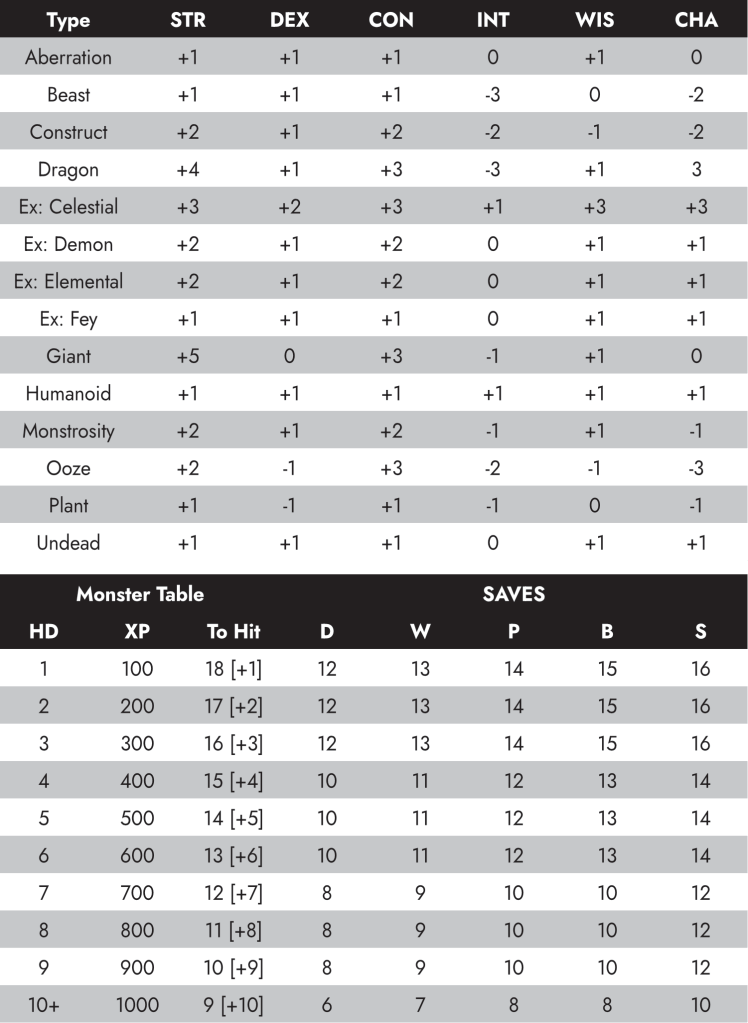
    Even after correcting for my maths error it seemed like way too much. I was already putting together a full bestiary for the dungeon, meaning one wouldn’t need to rely on OSE or another retroclone for their monster needs. Might as well alter the XP given for monsters–my design sensibility is admittedly a little more monster-fighty than most others in the space. I’ve had a blast in Luke Gearing’s OD&D game where we get awarded 100xp per monster hit die–so I used that as the baseline for establishing all monster XP.

    So:

    • I counted the monster XP up in every room of the dungeon.
    • I figured out my expected XP per level to get a Fighter to the expected levels I wanted them to be, character level 9 at dungeon level 12. (This required a separate spreadsheet that basically was divided into like 128 rows and was not particularly fun to do or look at.)
    • I counted how many rooms were to contain treasure.
    • I took the expected XP per level, subtracted the given monster XP, leaving the treasure per level value. I divided that by how many rooms contained treasure. (I obviously did not include any rooms that only contained magic items.) This gave me the Treasure Per Room value, which I used as a guideline for distributing my treasure.
    • Once I fully distributed the treasure in a way that made sense and was close to my guidelines, I added that up for Current Treasure Value.
    • I added Current Treasure Value and Monster XP and divided that by 4 to get the amount of XP a fighter would have at the end of the dungeon level if they did everything. (I also added the row above in Cumulative Fighter XP to uh, make sure it was cumulative.) 

    As you can see, it was a lot of work, but it all is right there in black and white. The spreadsheet works. 

    So that’s how I got the numbers that are in the book. If you’re a B/X traditionalist and don’t want to award that much XP for monsters, then the amount you need to redistribute throughout the level is right there in the column named “Monster XP.” Take that, divide it by the number of Treasure Rooms, add that much to each room that contains GP. There you go! 🙂

    Parts of this post were modified from a Castle Gygar Kickstarter update.


  • Dividing XP by HD

    Gary Gygax was wrong.

    …when he said this.

    After playing in Luke Gearing’s OD&D game for about a year I really began to love the simplicity of making monsters worth 100XP per Hit Die. It’s actually so simple, why did we ever move away from it?

    This is especially true in my games, where my Wizardry, Final Fantasy, Dragon Quest brain equates the primary way you level up to be killing monsters. Gold is, of course, worth more, and I write my material with that assumption and that work, but for my own system? My own games? I need not be 100% beholden to that. I like a fighty D&D game where the players take on big crazy monsters. I have all these fucking monster miniatures for a reason; I’d like to goddamn use them!

    But after a while we sort of started to see the flaw in the 100xp for HD. We were doing a lot of stuff up on Floor 1 of the megadungeon and killing all sorts of guys, some of whom were worth a lot of XP, and we are sort of high level–we’re talking 5, 6, 7th level fighters and magic users here, and with magic items coming out of our ass. It was trivially easy for us to nuke a party of 3HD monsters and move on with our day.

    So the new rule was instituted that The Formula suggested even in OD&D would be used: monster HD x 100 divided by player level or whatever it is. We all rapidly saw Our Gains go down the drain.

    I was never happy with this formula. For one thing the dungeon level doesn’t necessarily equate to what HD the monsters are, so this math really starts to fall apart depending on how much you’re doing outside of that box. For two, it only encourages you to go further into the dungeon, not to fight larger foes.

    Here’s my proposal:

    Each monster is worth a baseline of 100XP per HD. This is thrown into a big pool.

    So the players fight let’s say 5 3HD monsters. 300 x 5 is 1500xp. That’s the pool. Now we look at the players. The party is a 2nd level MU, a 4th level fighter, and a 3rd level thief. What we want to do is compare all of the player HD to the monster HD, and determine what share each player should get. This is the XP Cap of each player. Notably, we do not yet divide XP.

    In this situation, the thief is equal to the monsters’ HD and so is entitled to a full share of XP. The Fighter is at 4:3 and so is entitled to 75%. The Magic User is level 2 and at 2:4 and thus is entitled to 200% share.

    What this means is that each player takes the 500xp they are entitled to and then multiplies by their %. So the MU actually earns up to 1000xp from this encounter. The thief earns 500xp. The Fighter earns only 375xp.

    But wait: that seems like a lot so we need one more step. Each participant takes their XP from the pool from lowest to highest. So the Fighter first earns 375 XP, leaving 1125XP. Now we subtract the Thief’s 500xp leaving only 625 for the magic user. Less than their weighed 1000xp would have been, but still more than they would have earned otherwise.

    What this does is reward fighting a monster bigger than you but not necessarily encourage it as there is an upper limit to how much you’re going to earn. This group of orcs can only ever reward 1500xp. But in this formula, no XP is ever “lost.”

    Of course, this is also a lot of math. So if your party would rather not fuck around with it, you can just go with 100xp per HD. Or, idk, less, like Gary did, which carried over into B/X and AD&D. Maybe he was right after all, or maybe they wanted to discourage fighting by removing it from the XP progression. Who knows.

    (Also we should be adding multipliers based on certain monster special abilities, like 2e, but that’s another topic.)


  • EMOTIONAL STAKES

    Challenge accepted, motherfucker.

    A lot has been written already about Over/Under and it’s small mechanisms. As I said before, the main “action” players can take is to give each other money. And when the only thing you can do is make money, players start to hustle. But I think there’s one other thing you can do, and it kind of goes back to the reaction of the bosses, mod team and GM of the Chokespawn Incursion.

    So, in any traditional TTRPG, stakes are pretty easy to set up. The easiest is: Your character might die. Your character is going into a dangerous dungeon, or a haunted house, or a derelict spaceship, and probably there’s going to be some terrifying goblin or man-faced bat creature or alien abomination with eight mouths that is going to do so much damage that your character no longer has any hit points and will probably die, maybe with no recourse for resurrection. Hey, I don’t want my character to die! I like playing as this character! So, we do what we can to avoid that. No sweat.

    There’s lots of other ways to add stakes. The bad guys get ahold of an NPC the players like and want to save, or a magic cube that can destroy the world, or they have a bunch of money that the players want to rip off. Easy stakes. Five minutes, a GM can make the players invested enough to rigamarole them through some terrifying location with a bunch of silly bullshit they made up for the night.

    Over/Under has none of that.

    One of the problems with all those stakes I just outlined up above, though: it’s very easy to get the party invested in it. It’s very hard to get the party invested in each other.

    A lot of posts from GMs online start with a conundrum: My players won’t “roleplay with each other.” They don’t care about each other’s back stories or motivations. They’re all just sort of slapped together for this adventure I’ve made, but without that adventure, they wouldn’t really have a reason to care about each other.

    Now, this isn’t necessarily a problem to be solved. That’s the usual advice, and it’s basically correct. If the players don’t want to roleplay with each other, you probably shouldn’t force them to do so. They either will or won’t according to what they desire as players, and that’s fine. But.

    Over/Under is made almost exclusively of players roleplaying with each other. Revealing their backstories. Being invested in them. One of the first things I do after a big server-wide event (like last night’s Invasion of the Jovankabots–uhhh more on that later) is go around and check in on everybody. I gotta make sure Lily and Thoss and Noa made it through.

    These are characters who maybe I’ve actually only interacted with them two or three times before one of these events. Before Thoss ended up in the hospital, I interacted with them…twice? Once on a job and once a few days later to shit on their religious epiphany. But then when a technomancer needed to use me as a conduit to sort through Thoss’s memories, to separate their personality from the cybervirus corruption inside their brain? Berwick broke the fuck down crying for the first time in ten years. (Berwick spent those ten years on various spaceships, alone, doing jobs usually reserved for androids.) Berwick called out to his friend Thoss, apologizing for blowing them off, crying out for them to come back to consciousness.

    I met this player like fucking twice!

    But here’s the thing: This kind of relationship between our two characters, in this scene: now we have stakes. We have emotional stakes between us. This is why we’re doing this.

    The word “scene” really started to enter the vocabulary of not just me but multiple other players. The idea that our two (or three or four) characters end up in a little box theater together and we all kind of know how this should go, but also have no fucking idea what’s about to happen, but we all want it to be important, otherwise we wouldn’t be goddamn doing it. We WANT there to be STAKES. And in a game with no hit points, no macguffins, no “monsters” (villains, surely, but no true monsters), the only stakes left are emotional ones.

    That’s why the doomed yuri squad is so popular and why it’s brought the station to the brink of war like three fucking times already. Even though my character is asexual and definitely not interested in any kind of emotional or physical relationship with anyone (he’s not a people person and has asomphosomphobia from the decade alone in space), I as a player am always deeply invested to see anything from these chucklefuck lesbians because it seems like they are constantly having the most emotional moment of any one person’s entire life, this very second. Scenes that might take an entire two hour film to lead up to are happening seemingly every goddamn day between this lesbian polycule and I don’t think it’s possible for a semi-casual player like me to keep track of all of it, so when I catch any of it I’m down to clown with the rest of the server. (Tbh, I think former Union President Sanyang was assassinated purely because of the player’s complete disinterest in the plotline. You can’t be part of this station and not be at least a little invested in the doomed yuri squad.)

    When you give the players no outlet for stakes, they will create them. Emotional stakes are super easy to create when this is all you got, and IMO it’s something we could do to remember.


  • The Chokespawn Incursion

    This is going to be very very very long, so strap in.

    This post is about an incident that occured in Over/Under, a Mothership MMORPG run entirely in Discord. If you don’t care about that, safely ignore this post.

    Over/Under is still ongoing. This post may contain actionable intel. In addition, this is all from my perspective, perception, and mostly publicly-available posts on the server. I may get things wrong or portray things in the wrong light. In this post, I am not doing so as a manipulation tactic or any attempt to push a narrative or agenda. I am simply fallible.

    Ready?

    (more…)

  • I can’t anymore with the undead

    It has been fifty years and I don’t know the difference between a ghoul, a wraith, a wight, a ghost, a spectre.

    I’m done! Fuck this! It’s time to A) figure all of this out and then B) solve them for my own game and setting.

    I do not care how these terms were co-opted by Gary (or Dave, or Rob and Tim or whoever else). I am only interested in figuring out what they are for me, and extrapolating from there.

    (more…)